
This guide groups the inventory control techniques you actually need into four working categories and shows how to put them to work.
What Is Inventory Control?
Inventory control is the day-to-day discipline of managing the stock you already hold—knowing what you have, where it is, and when to reorder. It sits inside the broader practice of inventory management, which also covers forecasting and supplier strategy. Strong control is what turns a chaotic stockroom into a predictable, profitable operation.
Why Inventory Control Techniques Matter
Poor control shows up fast: stockouts that send buyers to competitors, dead stock that quietly expires, and emergency orders that wreck your margins. The right techniques reduce carrying costs, free up working capital, and give you the accurate stock data every other decision depends on.
1. Classification Techniques
Not every product deserves equal attention. Classification tells you where to focus.
- ABC Analysis ranks items by their share of total inventory value. “A” items (roughly the top 20% driving 80% of value) get the tightest control; “C” items get the lightest.
- VED Analysis (Vital, Essential, Desirable) sorts items by how critical they are to operations—useful for spare parts and manufacturing.
- FSN Analysis groups stock by movement speed (Fast, Slow, Non-moving) to surface dead stock early.
2. Replenishment & Ordering Techniques
These decide how much to order and when.
- Economic Order Quantity (EOQ) calculates the order size that minimizes combined ordering and holding costs.
- Reorder Point sets the stock level that triggers a new order, accounting for lead time.
- Safety Stock is the buffer that protects you against demand spikes and supplier delays.
- Min-Max and Just-in-Time (JIT) keep stock between set floors and ceilings, or pull inventory in only as needed to cut holding costs.
3. Tracking & Counting Techniques
Control is only as good as your data.
- Perpetual vs. periodic systems update stock continuously versus at fixed intervals—perpetual is the modern standard.
- Cycle counting verifies small subsets of inventory on a rolling schedule instead of one disruptive annual count.
- Barcode and QR scanning removes manual-entry errors at receiving, picking, and shipping.
- Batch and lot tracking follows grouped items for recalls, expiry, and traceability.
4. Stock Optimization Techniques
Finally, keep stock flowing and fresh: use demand forecasting to plan ahead, apply FIFO, LIFO, or FEFO rules so the right units leave first, and run regular dead-stock reviews to clear capital-draining items.
How to Choose the Right Inventory Control Techniques
Match the method to your size and stage. A small retailer may only need ABC analysis, reorder points, and barcode scanning. A multi-location distributor will layer in EOQ, cycle counting, lot tracking, and forecasting. Always start with classification—once you know your “A” items, every other technique becomes easier to apply.
Manual vs. Software-Driven Control
Spreadsheets can run these inventory control techniques, but they break down as SKUs and locations multiply: formulas go stale, counts drift, and no one trusts the numbers. Software applies these techniques automatically and in real time across every channel and warehouse.
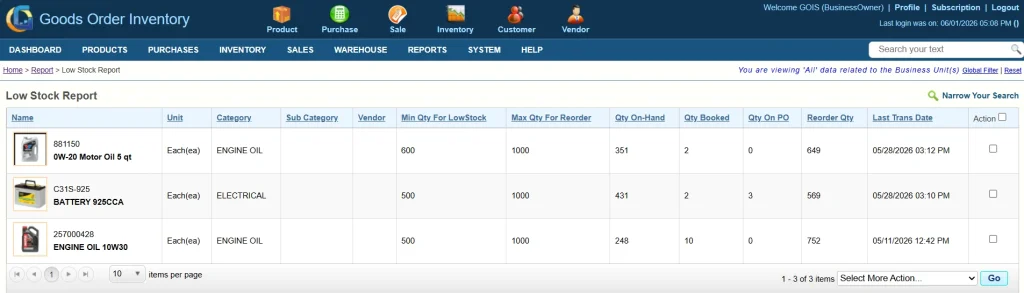
See your inventory clearly. GOIS automates ABC analysis, reorder points, barcode tracking, and lot control in one real-time cloud dashboard—no spreadsheets required. Request a demo
Key Takeaways
- Inventory control keeps you between costly overstock and costly stockouts.
- Group techniques into four jobs: classify, replenish, track, optimize.
- Start with ABC classification, then layer in reorder points and safety stock.
- Real-time software makes these techniques reliable at scale.
Frequently Asked Questions
What is the most important inventory control technique?
ABC analysis is the usual starting point because it tells you which items deserve the tightest control before you apply anything else.
What’s the difference between inventory control and inventory management?
Control is the hands-on management of existing stock—counting, reordering, tracking. Management is the wider strategy that also includes forecasting and supplier planning.
Can small businesses use these inventory control techniques?
Control is the hands-on management of existing stock—counting, reordering, tracking. Management is the wider strategy that also includes forecasting and supplier planning.
Conclusion
Inventory control isn’t about one clever trick—it’s about applying the right combination of classification, replenishment, tracking, and optimization techniques for your business. Get those working together and you cut waste, protect sales, and free up cash. The faster path is to stop running them by hand.
Ready to put these techniques on autopilot?
GOIS gives you real-time control across every product, channel, and warehouse. Request a demo today and see how smarter inventory management drives growth.
Request a Demo
Naushad Ahmed 
Naushad Ahmed is a technology expert at Goods Order Inventory (GOIS) specializing in inventory management, order fulfillment, and warehouse operations for small and mid-sized businesses. He shares practical insights on inventory control, stock accuracy, automation, and multi-location management to help businesses move beyond spreadsheets, reduce stockouts and overstock, and scale their operations efficiently.