
Businesses often ask when the right time is to replace Unleashed inventory software. Well, most businesses usually start with spreadsheets and switch to Unleashed to bring structure to inventory.
Initially, things feel under control, stocks are visible, purchase orders are tracked, and reports look decent.
But when growth happens, there will be more SKUs, warehouses, sales channels, returns, and increasing complexity.
That’s where what the system felt good at initially begins to feel rigid. Teams start creating workarounds, reports need manual adjustments, and the forecast doesn’t match the reality.
The ultimate result – slow operations and errors.
This is the actual time when you need to replace Unleashed inventory! But this is not the case of every business. That’s why we asked various customers the same question: what actually led them to replace their existing inventory management system?
Let’s understand the top reasons that growing firms noticed while upgrading the inventory system.
Top Reasons to Replace Unleashed Inventory Software System
Just keep in mind that growth changes everything! What software worked when you had 250 SKUs and one warehouse will not work in the same way when running multiple warehouses with 1000 SKUs. This situation demands replacing Unleashed Inventory Software, but it never happens overnight.
It builds up through multiple signals and operational gaps that you need to realise over time. Here are the common triggers:
Manual work is eating up too much time
As your business scales, the inventory volumes increase. But the teams that are depending upon Unleashed, find themselves:
- Manually performing stock reconciliations
- Keep exporting data to spreadsheets
- Double-checking the supplied data
- Manually adjusting forecasts
- Correcting stock mismatches
When manual effort increases and keeps increasing the pressure, then that’s a clear reg flag.
This is where businesses should look for deeper automation, implement smarter replenishment triggers, and access real-time dashboards with a modern inventory management solution.
Lack of Inventory Visibility with complicated spreadsheets
Inventory is the backbone of any business. To make your business run smoothly, you should also know:
- What’s in stock?
- What’s reserved at the backend?
- What’s incoming during peak time?
- What’s aging over the shelf?
- What’s at risk of stockout?
Limited visibility creates uncertainty and keeps you in a dilemma. If you can’t clearly track batch numbers, serial numbers, or multi-warehouse movement in real time, your business growth will be in trouble.
Companies exploring Unleashed alternatives often prioritize stronger traceability and clearer, live inventory control, especially in distribution and manufacturing environments.
The uncertainities leads into overstocking, understocking, and lost revenue.
Hear directly from our client @Dena Friedal about how GOIS streamlined their business. Watch the video
Still using the spreadsheets is part of the workflow
This is one of the biggest warning signs: if your team is still heavily dependent on Excel alongside Unleashed, it usually means the system is not ready to handle the complexity, and scalability isn’t handling complexity natively.
It commonly collapses when:
- It needs to track inventory across multi-location warehouses.
- Extracting visibility of bundled or assembled products
- Forecasting demands based on assumptions
- Analysing product margins
- Managing reporting across multi-channel
When spreadsheets become your “backup system,” leadership often begins planning to Replace Unleashed with a platform that centralizes everything in one source of truth.
Reporting with disconnected tools
Inventory decisions are always based on purchasing orders, sales, finance, and existing tools. If data isn’t centralized or gathered by disconnected systems, then reporting becomes slow and fragmented.
Common frustrations include:
- Needing manual exports for analysis
- Limited customization in reports
- Difficulty tracking real product margins
- Delayed visibility into stock performance
- Lack of a consolidated financial view
Modern businesses look forward for cloud-synced, real-time data across systems that allow teams to work with updated data and make informed data.
The System failing to keep up with the business growth
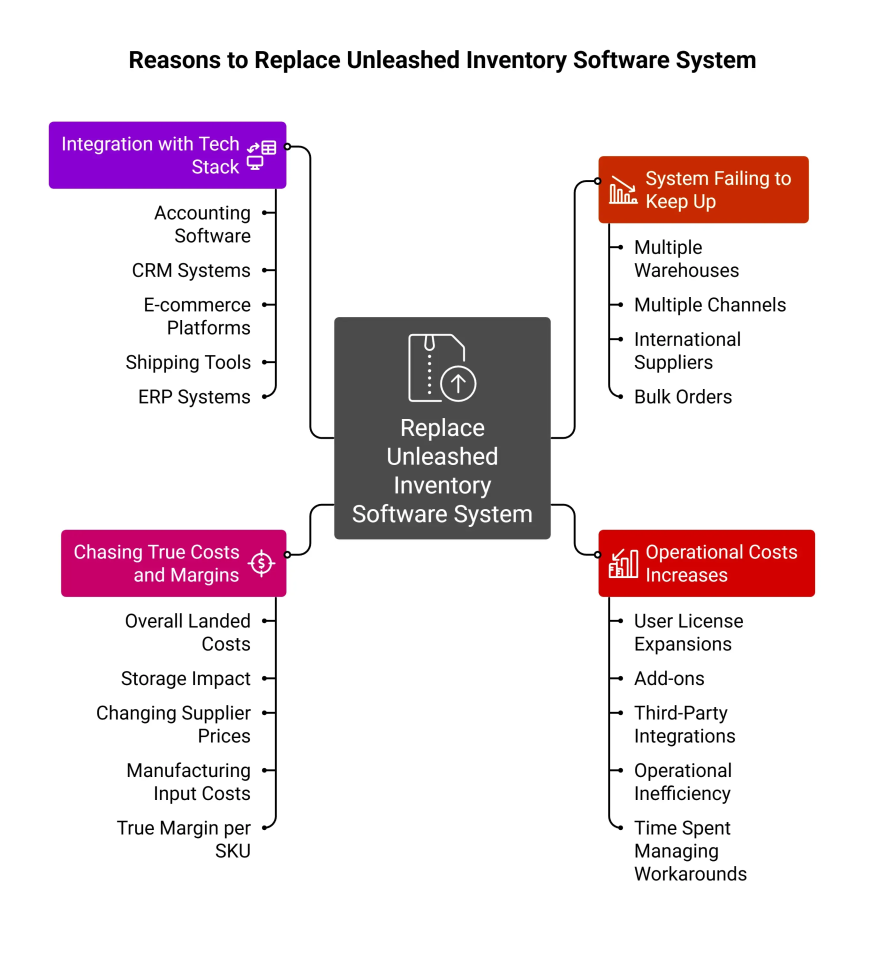
When your business start growing, you will switch to single warehouse to multiple warehouses, driving sales through multiple channels, collaborating with international suppliers with complex pricing structure and handling bulk orders.
As complexity increases, limitations become more visible.
Many companies don’t initially plan to replace Unleashed, but once transaction volumes increase and operational layers expand, your system feels stretched and it slow down the execution.
Operational costs increase without adding value
Don’t fall for initial pricing of software, becuase the total ownership cost of the inventory system includes:
- User license expansions
- Add-ons
- Third-party integrations
- Operational inefficiency
- Time spent managing workarounds
When subscription costs increase but operational friction remains at the same point, then it’s time to upgrade the system with powerful Unleashed alternatives.
Chasing to understand true costs and margins
One of the most dangerous blind spots in inventory management is inaccurate cost tracking. If you can’t clearly see:
- The overall landed costs
- Storage impact and dead stock on shelf
- Changing prices of supplier
- Manufacturing input costs
- True margin per SKU
You risk making decisions based on incomplete data. Modern inventory platforms allow deeper cost visibility and margin analysis, helping leadership optimize product portfolios.
Integration with your tech stack is limited
Inventory doesn’t work alone.
It must connect smoothly with:
- Accounting software
- CRM systems
- E-commerce platforms
- Shipping tools
- ERP systems
As companies migrate fully into cloud ecosystems, integration flexibility becomes critical.
In many Comparison evaluations, integration depth and API capabilities heavily influence the decision.
If your system creates silos instead of connections, growth slows.
Final Words
At the end of this blog, it is fair enough to say that replacing inventory software is not a small operational decision. Most companies don’t realize it until they end up with major blunders.
To help you understand the best time to switch to the modern inventory system, here we have listed top reasons that enables you realize how this shift happens gradually.
When your inventory system no longer supports speed, visibility, automation, and scalability, it stops being an asset and starts becoming a bottleneck. That’s when forward-thinking businesses begin evaluating stronger Unleashed alternatives and look forward for the specialized inventory management solutions like GOIS.
Is Your Inventory System Slowing You Down?
See What You’re MissingIf you are interested knowing the full features of GOIS like specialised products and how it helps you updrate the system then contact us.
Frequently Asked Questions (FAQ’s)
1. Why do businesses decide to Replace Unleashed Inventory Software?
Businesses typically choose to Replace Unleashed inventory software, when they experience rigid systems, lack of visibility, manual operations and rising operational cost. As operations grow more complex, companies often require deeper automation with modern inventory software.
2. What should businesses look for Unleashed alternatives?
While looking for Unleashed alternatives businesses should focus on scalability, deeper control over inventory management, clear stock visibility, automation features and more.
3. Is replacing Unleashed difficult?
Replacing any inventory system requires planning, especially around data migration and team training. However, modern platforms often provide structured onboarding and migration support, making the transition smoother than many businesses expect.
4. When is the right time to switch inventory systems?
The right time to switch is before operational bottlenecks start affecting revenue, customer experience, or decision-making. If workarounds are becoming normal and reporting feels unreliable, it’s worth exploring whether you should Replace Unleashed.
5. Will switching inventory software disrupt operations?
With proper implementation planning, disruption can be minimized. Most businesses transition in phases, ensuring data integrity, team training, and integration testing before going fully live on a new system.

Naushad Ahmed 
Naushad Ahmed is a technology expert at Goods Order Inventory (GOIS) specializing in inventory management, order fulfillment, and warehouse operations for small and mid-sized businesses. He shares practical insights on inventory control, stock accuracy, automation, and multi-location management to help businesses move beyond spreadsheets, reduce stockouts and overstock, and scale their operations efficiently.