Whether you are running a single storefront or managing multiple warehouses at different locations, the way you replenish inventory can make or break your customer experience, your cash flow, and ultimately your bottom line is impacted drastically.
You may know the frustration when a fast-moving product suddenly goes out of stock, customers are walking away, and on the other hand, slow-moving products pile up, blocking your capital that barely moves.
This is exactly where stock replenishment becomes critical.
Never Run Out of Stock Again
Automate inventory tracking and replenishment with GOIS for smarter stock control.
Optimize Stock Replenishment with GOIS →According to the reports, stockouts cost retailers nearly $1.73 trillion globally each year, while overstocking can increase the risk of holding costs by 20-30%. That’s not a small operational issue- but a silent profit leakage.
What do you mean by Stock Replenishment?
Stock replenishment is a strategically driven process of restocking inventory to maintain optimal inventory levels even during the peak time season. Smart stock replenishment helps meet customer demand without interruption.
Simply put, it helps answer three major questions:
- When should we reorder?
- How much should we reorder?
- Where should the inventory go?
Unlike traditional ordering methods, which are mainly based on assumptions, modern stock replenishment strategies use real-time sales data, extract demand patterns, and use intelligent forecasting to make accurate replenishment decisions.
How Does Stock Replenishment Work?
Stock replenishment typically follows one of a few common methods to prevent inventory distortion. Here are a few methods that really work:
1. Reorder Point Method, where you can pre-define the stock level. Whenever the inventory goes below that point, a reorder feature in an order and inventory management software triggers automatically. It helps you manage orders during peak season without experiencing a stockout.
2. Periodic Replenishment, where stock is reviewed and replenished at regular intervals on a weekly, bi-weekly, or monthly basis. This works for predictable, slow-moving items but can fail badly when the demand spikes.
3. Demand-Driven Replenishment, which is one of the smartest approaches to inventory replenishment. Instead of recording inventory based on assumptions, orders are driven by real-time sales data, seasonal trends, and customer demand patterns. It’s a dynamic, responsive, and far more accurate way of processing reordering.
4. Automated Stock Replenishment, to automatically monitor stock levels, analyze sales velocity, and trigger purchase orders- even before a human notices the low inventory.
Why Manual Replenishment Is Costing You More Than You Think
Let’s be honest, a lot of small and mid-size retailers are still using spreadsheets, gut instinct, or guesswork to manage their stock levels.
And that’s actually worked a decade ago, but today, with hundreds of movements in the retail environment, you need to take instant actions that are too fast for manual methods.
Here’s what manual replenishment really costs you:
- Human errors: Even a single missed reorder or a typo error can leave shelves empty during your busiest season and lose sales.
- Time draining: Staff spend hours counting stock, updating sheets, and chasing suppliers instead of serving customers.
- Delayed decisions: By the time you notice a product is running low, it’s often already too late to take action or survive that situation.
- Inconsistent ordering: Manually handling the inventory without a data backup is a major blunder. You will either over-order or under-order the products.
As per McKinsey, retailers using automated inventory tools reduce stock-outs by up to 80% and cut carrying costs by 20–30%, which are quite business-changing numbers.
The Power of Automated Stock Replenishment
How can automated inventory replenishment make a difference? Is it is really impactful?
Yes, modern replenishment software like GOIS (Goods Order Inventory System) is designed with next-gen features to handle modern stockreplenishment challenges.
But how?
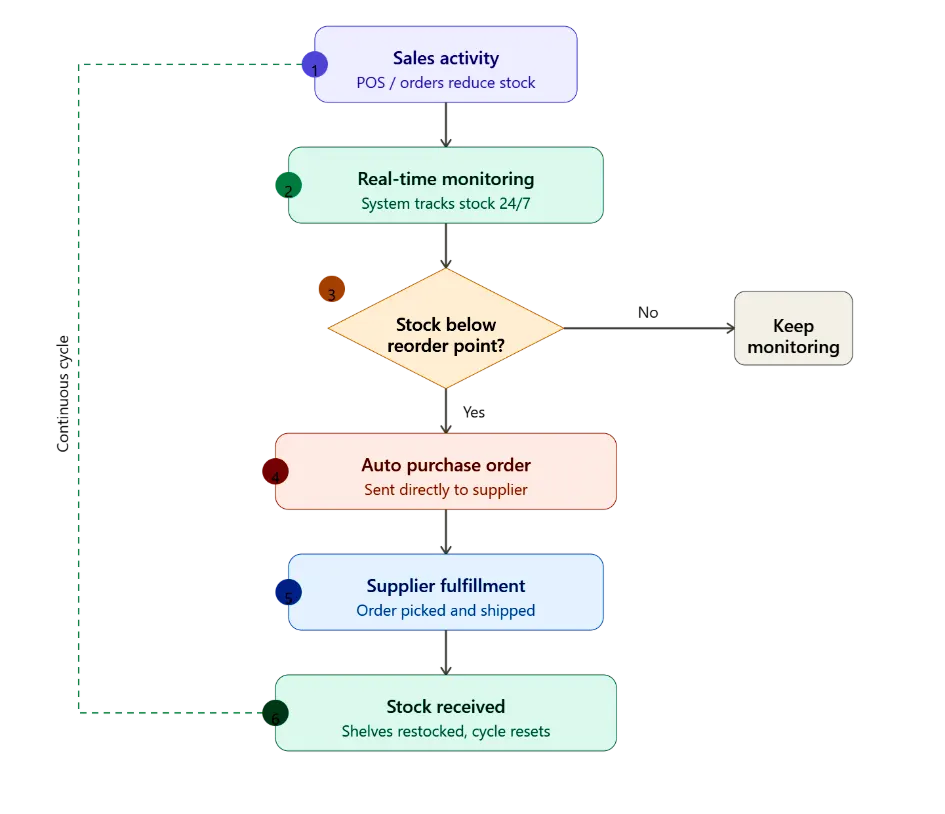
It provides you with a real-time view of your inventory by integrating with your purchasing, warehouse management, and point-of-sale systems. Here’s how the backend operates:
- Every location’s stock levels are continuously monitored by real-time inventory tracking.
- Reorder points are always precise because sales velocity analysis determines how quickly each product is moving.
- When stock reaches a predetermined threshold, automated purchase orders are created and dispatched to suppliers without the need for human intervention.
- Demand forecasting anticipates future requirements before they materialize by utilizing market patterns, seasonality, and previous tendencies.
- Your staff is immediately informed by low stock alerts, ensuring that nothing is missed.
As a result, you may spend more time expanding your business and less time battling inventory issues.
What is Retail Stock Replenishment and Why Does It Need a Different Approach?
Retail stock replenishment has its own set of challenges, which make it different from manufacturing or wholesale.
Inventory in retail is fast-moving and handled in a fast-paced environment where customer buying patterns shift quickly. Today’s trending product can be forgotten tomorrow.
Seasonal spikes depend upon holiday shopping, back-to-school, or festive seasons, which can triple your normal demand within days.
And with omnichannel retail on the rise, you now need to balance in-store stock with online fulfillment from the same inventory pool.
For retail, effective stock replenishment means:
- Keeping high-velocity items always in stock
- Clearing slow movers before they pile up
- Syncing inventory across in-store and online channels
- Maintaining supplier lead times to avoid delays
GOIS, an intelligent order and inventory management system, helps retailers do all of this in one unified platform, making retail stock replenishment faster, smarter, and far less stressful.
Understanding the Core Benefits of Getting Stock Replenishment Right in Business
When your inventory replenishment process is followed correctly, its benefits will roll out in every aspect of business, such as:
- There will be higher sales, and no more losing customers to stockouts.
- Cash flow becomes smoother as there is less capital locked up in excess inventory.
- Maintaining better supplier relationships with consistent data-backed orders leads to building trust.
- Happier staff as most of the everyday tasks are automated and less manual work is required.
- Leading to accurate financial reporting, real-time stock data means reliable numbers.
Final Words
At the end of the day, automated stock replenishment is about working smarter, not harder. In a retail landscape where margins are tighter, and customer expectations are hard to manage- you can’t afford to manage inventory with manual replenishment. Empty shelves mean losing potential sales or wasting capital on stock that isn’t moving.
For the busy season, for demand spikes, and for growth, automated stock replenishment helps you stay prepared in advance. And with a platform like GOIS, that level of control is more accessible than ever.
If you’re still relying on manual processes or outdated spreadsheets, now is the time to switch to a system that manages your customers and cash flow without glitches.
Frequently Asked Questions (FAQ’s)
How is stock replenishment different from inventory management?
Inventory management is the broad process of tracking, organizing, and controlling all your stock. Stock replenishment is a specific function within that focuses on restocking products to optimal levels when they run low.
How often should stock replenishment happen?
It depends on your product type and sales velocity. High-demand items may need daily or even real-time replenishment triggers, while slow-moving products may only need weekly or monthly review cycles.
What triggers an automated stock replenishment order?
A replenishment order is triggered when stock falls below a pre-set reorder point. Automated systems calculate this based on lead times, average daily sales, and safety stock levels.
Can small businesses benefit from automated replenishment?
Yes, regardless of size, small businesses can even benefit from automated replenishment. Even a single-store retailer can save time and reduce costly errors by using an affordable inventory system like GOIS, which helps automate the critical aspects of business.
What is safety stock, and how does it relate to replenishment?
Safety stock is a buffer quantity held above your minimum stock level to protect against unexpected demand spikes or supplier delays. It plays a crucial role in setting accurate reorder points.

Naushad Ahmed 
Naushad Ahmed is a technology expert at Goods Order Inventory (GOIS) specializing in inventory management, order fulfillment, and warehouse operations for small and mid-sized businesses. He shares practical insights on inventory control, stock accuracy, automation, and multi-location management to help businesses move beyond spreadsheets, reduce stockouts and overstock, and scale their operations efficiently.