Wondering how?
Have you ever faced a situation where suddenly your production line slows down, your team is confused, your inventory doesn’t match your needs, and the finished product comes out nothing like the design?
This all happens when your manufacturing unit is working with unclear, messy information. Commonly, your things were not updated and aligned.
The result: production delays, excessive waste, and a frustrated team trying to piece together a puzzle with missing pieces.
Impacts of Poor BOM Management
Evidence from industry reports indicates that BOM errors can add 40 minutes of processing time per defective part, resulting in delays of days or weeks. This not only inflates costs due to poor data quality costs the U.S. economy over $3.1 trillion annually, but also risks product quality and customer satisfaction. In debates surrounding automation versus manual processes, data suggests that integrated systems reduce human error, although small manufacturers may face implementation challenges.
In reality, building any product without strong BOM Management is like trying to assemble furniture without the instruction manual. You guess. You hope. You backtrack. And you end up wasting time, materials, and money.
Manufacturers can’t afford that kind of guesswork.
To accurately managed their product, what they need is a clean, connected, always-accurate structure that tells every team exactly what goes into the product: every part, every quantity, every source, and every step.
And when BOM Management solutions aligns with your workflow well- production runs smoother, decisions get faster, inventory stays under control, and quality becomes consistent.
BOM solutions is not just a list of components. It’s the backbone of accurate production. And today’s where manufacturing units are fast-moving, handling heavy manufacturing customizations, BOM matters more than ever.
However, let’s start with the basics, if you are really serious about implementing BOM management solutions.
What Is BOM Management?
Before we dig into the broad picture of its benefits and mechanism, let’s break down what is BOM management in a simple, practical way.
Any product you build, whether it’s a bicycle, a smartphone, or industrial machinery, has a list of materials that go into it. And that list is called a bill of materials.
Now imagine every part in that list has details: quantity, specifications, suppliers, costs, versions, and assembly notes. All of that data has to be tracked, updated, and shared with every team involved in production.
That entire process is BOM Management.
It’s the system that keeps your product information organized, accurate, and accessible. It ensures that the engineering team, purchasing team, production crew, and quality control team all follow the same blueprint and stay aligned at all phases of the production.
When done right, BOM Management gives you:
- Clear visibility into every component
- Maintaining accurate data at every production stage
- Conducting smooth communication across departments
- Faster and more consistent production without any hiccups
It’s what keeps your manufacturing process grounded, predictable, and running flawlessly.
Without it?
You get mismatched parts, wrong purchases, production delays, and products that never turn out the way they should.
That’s why implementing strong BOM Management sits at the heart of every successful manufacturing operation.
Why BOM Management Helps You Keep Accurate Production?
In the modern era, where order demands are soaring, manufacturers have to move fast to keep pace. Designs are constantly evolving, suppliers are throwing their tantrums, customers are shifting their demands, and production teams handle hundreds of moving parts at once. In that constant motion, BOM Management becomes the steady force that keeps everything aligned, structured, and in the right motion.
The truth is simple: when your BOM is clean and accurate, everything else runs more smoothly. When it isn’t, small issues spiral into costly blunders.
Here’s why BOM Management matters more than most teams realize, and contributes to maintaining accuracy levels in production:
1. Consistently Maintaining the Numbers at all Phases of Production!
Your product only turns out right when everyone works from the same instructions and is on the same page. A well-built BOM Management solution ensures every part, quantity, and step is clearly defined so nothing is left to guesswork.
2. Eliminating Confusion and Guesswork Between Teams!
Engineers might update a design before production starts. The purchasing team might change a supplier. Production might discover an assembly issue.
Without proper BOM Management, these updates stay scattered and disconnected from the team, which leads to mismatches and errors. This is where Bills of Material (BOM) keep everyone synced and updated with every single change.
3. It Protects You From Delays and Making Predictable Productions!
Missing a single component can halt an entire assembly line. With accurate BOM Management, you know exactly what materials you need and when, so production never gets held up waiting for parts.
4. BOM Saves You Money, Efforts, and Waste!
Manufacturing often deals with overordering, which ties up with cash. Underordering triggers rush purchases. Both are expensive to deal with.
This is where a good BOM Management helps you order smartly by keeping a strict track on stocks, enabling you stay cost-efficient and reduce waste.
5. Minimizes Concerns Related to Production Quality!
A product built with the wrong specification, wrong material, or wrong version creates headaches for manufacturers.
Implementing accurate BOMs means consistent quality, no matter how large or complex the production run.
6. Strongly Supports Compliance and Traceability!
Some industries require full visibility into every part used in a product. BOM Management creates a clear audit trail that helps you stay compliant, trusted, respond to recalls, and maintain product safety.
7. Enables you to Scale Your Manufacturing Without any Risk of Crash!
As your product line grows, your BOM complexity also starts growing with it. Without structured BOM Management, scaling quickly converts into blunders. With it, growth becomes repeatable and controlled.
In a nutshell, Bills of Material (BOM) is the foundation that holds your entire production ecosystem together and keeps it in a rhythm. When it’s strong, your operations are strong. When it’s weak, everything starts to crack.
Types of BOMs That You Need to Know
Not all products are built the same way. So naturally, not all BOMs follow the same structure. Different manufacturing needs involve different stages, and product complexities require different types of BOMs. That’s why it is important to implement the right BOM Management that actually enables you meet perfection in production.
Here are the most common types of Bills of Materials you’ll see in manufacturing:

1. Manufacturing BOM (MBOM)
This is the version used on the production floor. It lists every material, part, component, and subassembly required to physically build the product.
MBOMs include:
- Exact quantities
- Assembling steps
- Packaging requirements
- Tools or resources needed
Without a well-managed MBOM, production teams end up improvising, and that process never ends well.
2. Engineering BOM (EBOM)
Created by the engineering or design team, the EBOM reflects the product’s design intent. It includes all the parts required for prototypes, testing, or early-stage builds.
EBOMs often contain:
- CAD model references
- Material specifications
- Design variations
- Version history
Since engineering updates take place often, that’s why BOM Management becomes critical to prevent outdated data from slipping into production.
3. Configurable BOM (CBOM)
Some products come with customer-selected options that include different colors, features, sizes, and performance levels. A CBOM captures all possible variations, so the final BOM adjusts based on the customer’s choices.
This type of BOM supports:
- Mass customization
- Personalized configurations
- Dynamic assembly instructions
Strong BOM Management ensures every variation stays accurate and ready for production.
4. Software BOM (SBOM)
Modern products often combine hardware and software. An SBOM lists all software elements:
- Libraries
- Dependencies
- Modules
- Open-source components
This is becoming essential for cybersecurity and compliance.
Quick Comparison Between Top-Level vs. Subassembly BOMs
Complex products also use multiple layers of BOMs.
- Top-Level BOM: Lists big components or modules in the system.
- Subassembly BOM: Breaks down each module into smaller parts for more visibility.
For example, a car’s top-level BOM includes the engine, transmission, and body. Each of those has its own subassembly BOM with detailed components.
Organized BOM Management keeps all these layers connected so nothing gets lost or overlooked and allow your teams stay connected at all phases of production.
What are the Key Elements of BOM Management?
A strong BOM is a well-structured, detailed document that gives production teams everything they need to build the product correctly, every time. Effective BOM Management ensures each element stays accurate and updated throughout the product lifecycle.
Here are the core components that make BOM work smoothly and empower at the back.
| BOM Element | What It Means | Why It Matters |
|---|---|---|
| BOM Level | Shows the hierarchy of components (Level 0 = finished product). | Makes complex structures easy to navigate and manage. |
| Part Number | Unique identifier assigned to each component. | Prevents confusion and ensures accurate communication across teams. |
| Part Name | Readable name for the component. | Helps teams quickly recognize and reference parts. |
| Description | Additional details about the part (material, size, function). | Reduces guesswork and clarifies specifications. |
| Quantity | Number of units needed for each part. | Directly impacts inventory, procurement, and production planning. |
| Unit of Measure (UoM) | Measurement format—pieces, meters, kg, etc. | Ensures everyone uses consistent measurement standards. |
| Phase | Lifecycle stage of the component. | Prevents the use of outdated or retired parts. |
| Procurement Type | Indicates if parts are purchased, manufactured, or outsourced. | Aligns purchasing, planning, and production workflows. |
| Reference Designators | Identifies exact placement of a component (mostly in electronics). | Ensures precise assembly and reduces placement errors. |
| BOM Notes | Extra instructions or handling details. | Helps teams avoid errors and maintain quality. |
What are the Core Benefits of BOM Management in Manufacturing?
If you are still unsure about what benefits it brings to your manufacturing, then consider these:
- Creates a Clear Production Blueprint To Avoid Confusion
A well-structured BOM offers a complete view of all materials, components, and steps needed for production, reducing missed tasks, rework, and delays
- Boosts Accuracy Across Processes and Stages of Production
With exact quantities and specifications listed upfront, BOM management drops the errors in procurement, planning, and assembly. It leads to consistent, high-quality output.
- Improves Team Collaboration Across All Channels
A BOM acts as a unified platform for engineering, production, and quality teams, ensuring everyone works with the same information and updates.
- Optimizes Inventory Levels and Maintains Numbers
Knowing precisely what materials are required helps strike the right balance between overstocking and stockouts, improving operational flow and reducing costs.
- Enhances Cost Visibility and Removes Guesswork
BOM data makes it easier to track material costs, understand cost drivers, and identify savings opportunities across the product lifecycle.
- Enables Smooth Change Management with Every Update
As products evolve, a well-managed BOM makes it simple to update component lists and align production with the latest design changes.
- Supports Regulatory & Quality Compliance
Detailed component tracking helps manufacturers maintain traceability, meet industry standards, and simplify audits or recalls.
- Strengthens Product Lifecycle Management
From design to after-sales service, an accurate BOM supports better planning, maintenance, upgrades, and long-term product reliability.
10 Tips to Streamline Your BOM in Manufacturing
1. Centralize Your BOM Data
Keep all versions, components, and updates in one accessible system to avoid scattered information and inconsistencies.
2. Use Standardized Naming & Numbering
Maintain consistent part names, codes, and descriptions so teams can easily identify and track components.
3. Build a Multi-Level BOM Structure
Break down assemblies into clear subassemblies for better visibility and accurate production planning.
4. Implement Strong Version Control
Track revisions with dates, owners, and change notes to ensure teams always use the latest BOM.
5. Integrate BOM With ERP/MRP Systems
Sync BOM data with procurement, inventory, and production workflows to eliminate manual updates and duplication.
6. Audit BOM Regularly
Schedule routine checks to validate quantities, materials, alternates, and dependencies before they become costly errors.
7. Document Every Supporting Detail
Attach drawings, datasheets, tolerance specs, certificates, and instructions so teams have complete clarity during production.
8. Involve Cross-Functional Teams Early
Collaborate with engineering, procurement, design, and manufacturing teams to catch issues before production begins.
9. Automate Wherever Possible
Use digital tools to automate material calculations, cost roll-ups, and change tracking to minimize manual mistakes.
10. Track Supplier Changes Proactively
Monitor component availability, lead times, and alternates to avoid disruptions and ensure smooth production flow.
Get the Best BOM Management With GOIS
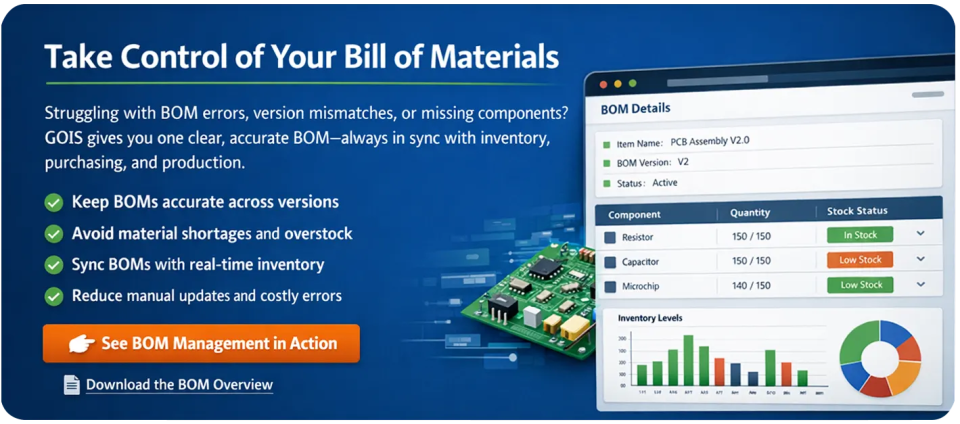
Managing a Bill of Materials doesn’t have to be complex. With GOIS, you get a powerful, user-friendly, and fully integrated BOM management solution designed to simplify production workflows, improving team coordination, and eliminating costly manual errors.
From centralized data to real-time updates, GOIS ensures your teams always have accurate, actionable insights to build faster, smarter, and more efficiently. Whether you’re scaling operations or optimizing manufacturing processes, GOIS delivers the clarity and control you need to stay ahead.
Final Words
At the end of this blog, it is fair enough to say that efficient BOM management is the backbone of a smooth manufacturing process. It impacts everything, right from production accuracy and cost control to team collaboration and product quality.
By adopting structured practices and using a robust platform like GOIS, manufacturers can streamline operations, reduce risks, and ensure every product is built right the first time.
A well-managed BOM isn’t just a document it’s a strategic asset that drives consistency, agility, and long-term success.
Frequently Asked Questions (FAQ’s)
1. What is a Bill of Materials (BOM)?
A BOM is a detailed list of all components, materials, and instructions required to build a product from start to finish.
2. Why is BOM management important in manufacturing?
Accurate BOM management ensures proper planning, reduces errors, improves efficiency, and helps maintain consistent product quality.
3. Can BOM management help reduce production costs?
Yes. By providing visibility into component costs, quantities, and alternatives, BOM management helps optimize procurement and reduce unnecessary spending.
4. How does GOIS improve BOM management?
GOIS centralizes BOM data, enables real-time updates, integrates with inventory and production, and reduces manual errors—making the entire process faster and more reliable.
5. What industries benefit most from BOM management?
Manufacturing sectors like electronics, automotive, machinery, consumer goods, medical devices, and aerospace rely heavily on accurate BOM management for smooth operations.

Naushad Ahmed 
Naushad Ahmed is a technology expert at Goods Order Inventory (GOIS) specializing in inventory management, order fulfillment, and warehouse operations for small and mid-sized businesses. He shares practical insights on inventory control, stock accuracy, automation, and multi-location management to help businesses move beyond spreadsheets, reduce stockouts and overstock, and scale their operations efficiently.