Here’s how it works, with a worked example and an honest look at where it falls short.
What Is Economic Order Quantity (EOQ)?
Economic Order Quantity (EOQ) is the optimal quantity to order each time you replenish a product so that the combined cost of ordering and holding inventory is minimized. Order in large batches and you reduce ordering frequency but raise holding costs. Order in small batches and you do the reverse. EOQ pinpoints the quantity where those two costs balance. It’s one of the most practical inventory control techniques for any purchasing team.
The EOQ Formula Explained
EOQ = √(2DS / H)
Where:
- D = annual demand in units
- S = ordering cost per order (setup, shipping, handling, admin)
- H = annual holding cost per unit (storage, capital, insurance, obsolescence)
Step-by-Step EOQ Calculation
Example: You sell 12,000 units a year (D). Each order costs $50 to place (S). Holding one unit for a year costs $3 (H).
- Multiply: 2 × D × S = 2 × 12,000 × 50 = 1,200,000
- Divide by H: 1,200,000 ÷ 3 = 400,000
- Take the square root: √400,000 ≈ 632 units
So ordering about 632 units per order minimizes your total inventory cost. From there you’d place roughly 19 orders a year (12,000 ÷ 632).
The Logic Behind Economic Order Quantity
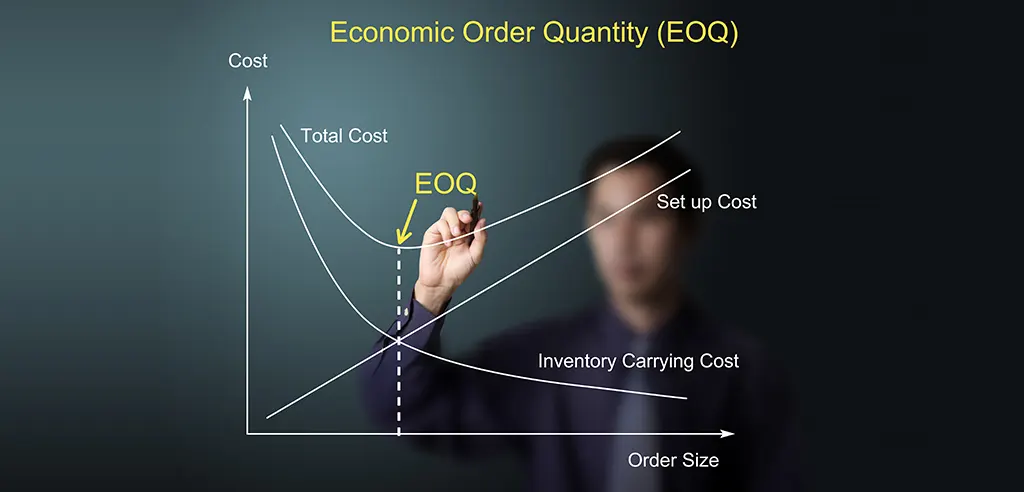
As order size grows, you place fewer orders, so total ordering cost falls. But larger orders mean more inventory sitting on shelves, so holding cost rises. Total cost is the sum of the two curves, and it bottoms out exactly at the EOQ. That’s why the formula works—it’s solving for the lowest point on the combined cost curve.
EOQ Assumptions and Limitations
EOQ is powerful but built on tidy assumptions that real supply chains often break:
- Constant, known demand — EOQ assumes steady sales; seasonal or volatile demand weakens it.
- Fixed costs — ordering and holding costs are treated as stable.
- Instant replenishment — it ignores lead time on its own.
- No quantity discounts or minimum order quantities (MOQs) — bulk pricing can make a larger order cheaper overall.
When EOQ Breaks Down
If a supplier offers a discount at 1,000 units and your EOQ is 632, the discount may beat the “optimal” order. If demand swings seasonally, a single annual EOQ misleads you—recalculate per period instead. Treat EOQ as a strong starting estimate, then adjust for the real constraints you face.
EOQ vs. Reorder Point vs. Safety Stock
These three work together, not in competition:
- EOQ tells you how much to order.
- Reorder point tells you when to order.
- Safety stock protects you between orders against surprises.
Used together, they form a complete replenishment system.
Calculating EOQ in Practice
You can run EOQ in a spreadsheet, but the inputs—annual demand, ordering cost, holding cost—change constantly, and a static formula goes stale. A cloud inventory management system pulls live demand data, recalculates EOQ as conditions shift, and pairs it with automated reorder points so the right quantity is suggested at the right time.
From there, the optimized quantity flows straight into a purchase order system and requisition workflow, while built-in reporting and analytics track your ordering and holding costs over time—so EOQ stays accurate as your business grows.

Order the right amount, every time. GOIS combines EOQ logic with real-time demand and reorder alerts so you stop over- and under-ordering. Request a demo
Key Takeaways
- EOQ = √(2DS/H) finds the order size with the lowest total inventory cost.
- It balances ordering cost against holding cost.
- Watch its assumptions: steady demand, fixed costs, no discounts.
- Pair EOQ (how much) with reorder point (when) and safety stock (buffer).
Frequently Asked Questions
What does Economic Order Quantity actually minimize?
The total of ordering costs plus holding costs for a product over a year.
Is EOQ still useful with variable demand?
Yes, as a baseline—but recalculate it for each season or demand period rather than using one annual figure.
How does Economic Order Quantity handle bulk discounts?
The basic formula doesn’t. Compare the EOQ cost against the discounted larger-order cost to decide which is cheaper overall.
Conclusion
EOQ gives you a defensible answer to a question most businesses guess at: how much should we order? Use the formula as your starting point, adjust for discounts and demand swings, and connect it to your reorder point and safety stock. Automate the inputs and EOQ stops being a one-time spreadsheet exercise and becomes a living part of your purchasing.
Let Real-Time Data Drive Your Order Quantities
GOIS turns EOQ into automated purchasing with live demand data, optimized order quantities, and intelligent reorder alerts.
Request a Demo
Naushad Ahmed 
Naushad Ahmed is a technology expert at Goods Order Inventory (GOIS) specializing in inventory management, order fulfillment, and warehouse operations for small and mid-sized businesses. He shares practical insights on inventory control, stock accuracy, automation, and multi-location management to help businesses move beyond spreadsheets, reduce stockouts and overstock, and scale their operations efficiently.