
One day, everything seems in place, and the next day, you’re seeing missing items, especially when you don’t know what or how much you are selling.
Without ecommerce inventory tracking in place, it’s common that extra stock you didn’t plan for, or orders you can’t fulfil because your system says “in stock” while your shelves say otherwise.
Sounds familiar?
You’re not alone. A recent industry survey revealed that 67% of businesses struggle with inaccurate stock data, and most of them blame one simple issue, poor stocktaking.
And it makes sense. When stocktaking is rushed, inconsistent, or done on outdated spreadsheets, your entire operation starts feeling the pressure:
- Delayed order fulfilment
- Unsatisfied customers
- Overstocking that drain up your cash
- Stockouts that kill sales
- Endless cycle of “Why don’t the numbers match?”
All these pointers lead to frustration. But here’s the good news: fixing stock accuracy is easier than you think, especially with the right stocktaking strategy and modern tools.
See How Easy Accurate Stocktaking Can Be
Learn how to fix stock accuracy, speed up counts, and stay audit-ready all year.
Stocktaking- What It Really Means?
If you’ve ever walked through your warehouse wondering, “Why doesn’t my system match what I’m seeing on the shelves?” that’s exactly where stocktaking becomes your reality check.
Many businesses treat stocktaking as a task they “have to do,” but in truth, it’s the foundation of how well your entire operation runs.
So, What Is Stocktaking?
Think of stocktaking as a health check-up for your warehouse and inventory. Instead keep searching for a formal stocktaking definition- take it as a stock audit process.
| Inventory Turnover Ratio: The Silent Engine of Lasting Prosperity – Read More |
It’s the process of physically counting, verifying, and recording every item you have in your warehouse or store. Moreover, stocktaking enables you to compare those numbers with what your system says.
In simple words, Stocktaking tells you what stock you actually have in the warehouse, not what you think you have.
Why Businesses Can’t Skip Stocktaking
Whether you’re in retail, wholesale, manufacturing, or eCommerce, stocktaking helps you:
- Confirm how much inventory you truly have
- Spot missing, damaged, or misplaced items
- Fix mismatches through inventory reconciliation
- Plan purchases and restocking accurately
- Maintain clean records for audits or compliance
And here’s the real truth:
| 43% of small and mid-sized businesses face stockouts because their inventory counts are wrong. You may rely on inventory management software, but the role of stocktaking can’t be underestimated. |
Most of this happens because stocktaking is still done manually or inconsistently, and errors begin to stack up fast.
The Role of Stocktaking in Modern Warehouse Operations
In today’s era, warehouses are under constant pressure to manage multiple things at the same time. Right from speedily moving the orders, responding to random returns, to managing items’ shift locations constantly, it requires serious inventory management techniques.
Without proper stocktaking and a reliable stock control system, it’s easy for errors to slip in unnoticed.
That’s why stocktaking isn’t just a counting exercise – it has become a core part of warehouse stock management that keeps every other operation running smoothly.
Why Stocktaking Accuracy Matters For Your Business?
If you’ve ever had a customer waiting, a supplier calling, or a manager asking- Do we have this item in stock right now?
And that moment if you started looking here and there to get the real numbers of stock on hand, then you know exactly how stressful inaccurate inventory can be.
In 2026, stock accuracy isn’t just helpful… it’s non-negotiable.
No matter how you take it, the cost of mismatched numbers will be huge. Here are a few stats explaining accuracy and inventory:
- 43% of small businesses don’t track inventory or do so using a manual system.
- 34% of businesses still shipped late because of inadvertently sold products that as not even in stock.
- Inventory distortion, whether stockouts or overstocks, costs an estimated $1.1 trillion globally.
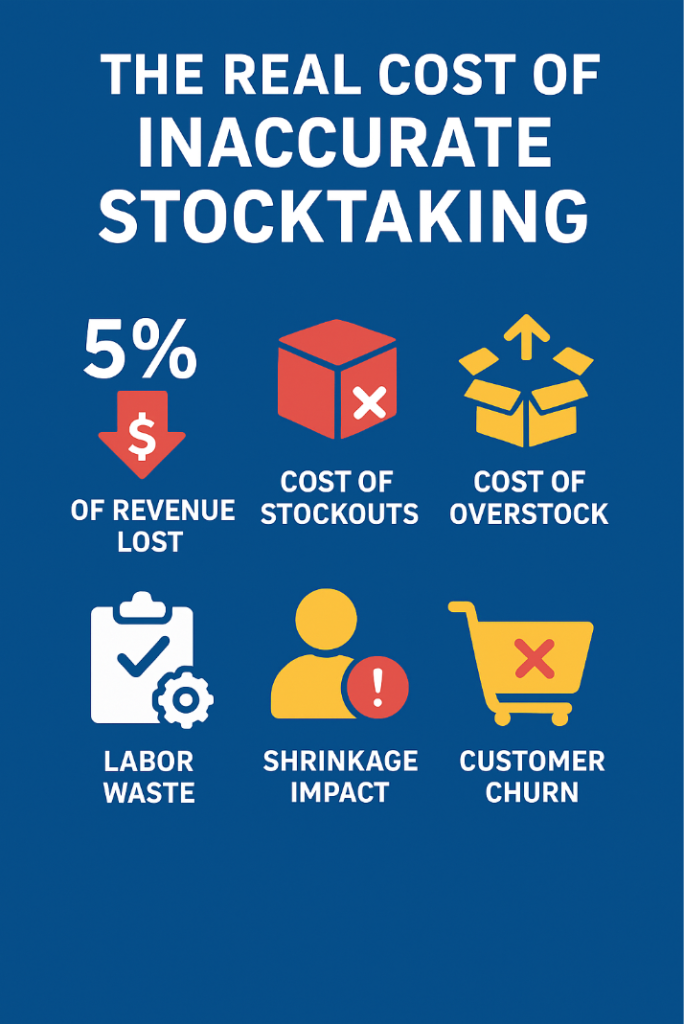
Still taking it easy and wondering why accurate stocktaking is such a big deal even in small businesses?
It’s important because everything in your business depends on it, whether it be order fulfilment, procurement, warehouse planning, cash flow, or customer satisfaction. When your numbers are wrong, every decision you make will be on shaky data. This is where 68% of warehouses face delays due to incorrect or outdated inventory counts.
Accurate Stock Counting Translates into Better Operations, Fewer Surprises
Here’s what occurring inventory accounting brings on the table:
1. Real-Time Visibility Of Inventory
You always know:
- What’s in stock
- What’s running low
- What’s missing
- What’s reserved
- What’s ready to ship
This means fewer last-minute surprises and smoother inventory workflow management.
2. Faster, Smarter Decision-Making
The entire process of supply chain can be well planned right from buying, stocking, and planning as they are based on facts, not guesswork.
3. Save Cost and Efforts
Stock accuracy improvement can minimize:
- The risk of overstocking
- Stock holding costs
- Need of an emergency purchase
- The cost returns & re-picks
4. Satisfying Customer Experience
You can promise delivery dates confidently and fulfill orders without delay.
5. Clean Financial & Audit Records
When your stock counts match your system, audits become simple and stress-free – a win for every business.
Why It Matters More in 2026
The boom of the ecommerce industry leads to complex warehouse stock management which may demand for:
- Omnichannel fulfilment
- Same-day delivery expectations
- Higher product returns
- Faster order cycles
…in entire scenario, there’s zero tolerance for stock errors.
This is where your competitors are leveraging tech-driven inventory counting tools to improve accuracy. If your stocktaking is still manual or inconsistent, you’re automatically falling behind.
What are the Best Stocktaking Methods For Small Businesses in 2026?
So, what stock audit best practices do you need to adopt to achieve stocktaking accuracy?

1. Using Just-In-Time (JIT) Inventory Management
Just-in-Time (JIT) is a lean inventory approach where you get the goods only when you actually need them. Instead of piling up stock, you replenish based on real demand. It helps reduce storage costs, waste, and cash tied up in excess inventory.
How JIT Approach Help in Stock Accuracy?
- There will be fewer inventory counts, misplace, and tracking.
- Fewer stock discrepancies caused by overstocking.
- You will get cleaner records because there will be small stock movements.
How JIT Works?
JIT actually uses the “pull” system, where items are placed on order when the existing stock reaches a trigger point.
Quick Tips to Implement It
- For seamless order processing, build a dependable relationship with the supplier.
- Use AI-powered demand forecasting tools.
- Start with fast-moving and low-risk items.
2. Adopt Cycle Counting Instead of Annual Stocktakes
Instead of conducting a large annual, disruptive physical inventory count, it is worth implementing a cycle count program to improve inventory accuracy. Conduct small, frequent stocktake, which helps catch the errors early and maintain clean data throughout the year.
How Cycle Counting Improves Accuracy
- Enables you to discover discrepancies sooner.
- Reduces warehouse downtime and complex yearly counts.
- Keeps inventory continuously updated with exact numbers.
How does it work in reality?
Count a small set of SKUs daily/weekly, as it enables you to focus on high-value and fast-moving items.
Quick Implementation Tips
- Prioritize items using ABC analysis
- Fix a schedule of daily or weekly stock counting schedule
- Use a barcode scanning system to maintain scanning consistency
3. Standardize Stocktaking Procedures
For accurate inventory reconciliation, have a clear stocktaking method in place. Every employee counts stock differently, which leads to errors. Standardizing the inventory counting process so that everyone follows the same steps every time.
How Standardization Improves Accuracy?
- Eliminates guesswork and manual mistakes.
- Maintaining frequent stock counting across the team.
- Speeds up the overall stock audit process.
How does it work?
Create a step-by-step Stocktaking process explaining how to count, move, label, and verify each item while stocktaking.
Quick Implementation Tips
- Train staff on counting rules and enable them to follow a standard procedure.
- Use written checklists and make them follow the same careful steps.
- Review and update SOPs quarterly to get an accurate inventory.
4. Use Barcode or RFID-Based Tracking
Manual entry always invites errors. Mistyping quantities, skipping items, writing wrong SKU codes, or forgetting to update the system are common. No matter how small or complex your inventory stock counts are, manual tracking always leads to inconsistencies. This is where barcode and RFID systems eliminate these issues by automating the product scanning, tracking, and stock updates.
How Automation Improves Accuracy in Stocktaking?
- Barcode scanners bridge between physical items and digital inventory records.
- Instantly capturing the data by scanning item details.
- No need to enter SKU codes, as scanners pull the exact data from tags.
- Speed up the counting cycle and full stocktakes.
Barcode vs. RFID (Quick Comparison)
| Feature | Barcode | RFID |
|---|---|---|
| Scan Range | Must be scanned one by one | Can read multiple tags at distance |
| Speed | Fast | Extremely Fast |
| Cost | Low | Higher |
| Best For | Small to medium warehouses | Large, complex, fast-moving warehouses |
How does it work practically?
Each item is tagged with a barcode or RFID chip, so whenever the product is scanned, it automatically updates the system with the location, movement, and quantity.
Quick Implementation Tips
- Start with barcodes, as they are low in cost.
- Upgrade to RFID if you are holding large warehouses.
- Train staff on handling scanners properly and make use of automated stock counts.
5. Optimize Warehouse Layout and Labelling
A cluttered or poorly labeled warehouse is one of the biggest reasons items go missing. It leads to stock variances, slow picking and inaccurate counts. When staff can’t find products quickly or your shelves are not clearly marked, your stock accuracy drops instantly.
How a Better Layout Improves Stock Accuracy?
- Offering clear counts, logical and labelled racks.
- When everything is labelled, there will be fewer item misplacements.
- Ensuring clean, organized shelves to verify stock
How does this strategy work?
Optimizing warehouse layout and proper labelling can help organize items by category, volume, or frequency of movement. Label every rack, bin, and shelf clearly for quick access.
Quick Implementation Tips
- Use color-coded zones
- Keep fast-moving items closest to dispatch
- Review layout every 6–12 months
6. Integrate a Real-Time Inventory Management System
A centralized system ensures every stock movement is recorded instantly, eliminating delays and data mismatches.
How Software Improves Accuracy
- Real-time visibility
- Automated reconciliation
- Reduced manual updates
How Does It Work?
Each sale, receipt, return, or transfer updates the system automatically and ensures that inventory counts always match reality.
Quick Implementation Tips
- Choose cloud-based solutions
- Integrate POS, WMS, and ERP
- Set user permissions to avoid unauthorized changes
7. Train Your Staff for Consistent Stock Handling
Even the best system fails if people don’t follow procedures correctly. Training ensures every item is handled, stored, and counted the right way.
How Training Improves Accuracy
- Fewer counting mistakes
- Better labeling and stocking discipline
- More consistent data entry
How to Train Your Staff?
Teach staff how to pick, receive, count, record, and move goods using a uniform method.
Quick Implementation Tips
- Run periodic refresher sessions
- Provide micro-training on scanners or devices
- Reward teams for accuracy improvements
How to Conduct an Accurate Stocktake in Your Warehouse?
If your stock counts feel complex, slow, inaccurate, and full of surprises- then you are not alone. Most warehouses are facing the same scenarios because of misplaced items are misplaced, poor labeling of products, and the team is following an inconsistent counting method.
So what’s the solution?
Accurate stocktakes don’t come from working harder. It’s time for smarter and systematic decisions. A reliable stocktake helps you:
- Eliminate stock discrepancies
- Optimize warehouse stock management
- Plan procurement with confidence
- Maintain clean records for audits
- Deliver faster and more accurately
To achieve this, you need to follow the right structure and advanced tools. So what is the ideal step-by-step stocktaking process to improve inventory accuracy? Here’s a quick overview of the stocktaking process:

In a nutshell, how will you improve the stock counting process? This is where GOIS outshines and makes stocktaking 10X easier for the businesses.
Traditional stocktakes fail because the entire process relies too heavily on manual work, paper lists, and outdated systems. But with GOIS (Good Order Inventory System), transform the entire workflow with:
- Real-time barcode and RFID-based stock counting as GOIS integrates seamlessly with handheld scanners- no double entries and discrepancies.
- Mobile stocktaking from anywhere and eliminating the need to carry a bulky list.
- Automating cycle counting without shutting down operations.
- Report generation that helps you stay audit-ready with zero stress.
Conclusion
At the end of this blog, it is fair enough to say that stocktaking isn’t just a warehouse activity. Well, it’s the backbone of operating the warehouse efficiently. All you need is to have the right structure and a powerful inventory counting tool like GOIS to eliminate delays, errors and implement smart procurement decisions.
Ready to restructure the inventory counting process? Let GOIS access the stock counting process and enable you to implement a custom warehouse management system. – Schedule a demo
Frequently Asked Questions (FAQ’s)
1: Why is stocktaking important for my business?
Stocktaking shows what you actually have in your warehouse. It helps you spot missing items, slow movers, wrong counts, and damaged stock before they turn into money losses. Accurate counts = better planning and fewer surprises.
2: How often should I do stocktaking?
Do a full stocktake once a year.
But also run cycle counts weekly or monthly for better accuracy.
Fast-moving and high-value items should be counted more often.
3: What’s the best method for stocktaking?
The right method depends on your warehouse size and speed:
- Full count – everything at once
- Cycle count – small counts more often
- ABC method – count A-class items more, C-class items less
Most growing businesses pick cycle counting because it saves time and avoids shutdowns.
4: How can I reduce errors during stocktaking?
Prepare before you start: clean the area, label racks clearly, freeze stock movements, and assign roles. Use barcode scanners or an inventory app like GOIS to avoid manual entry mistakes.
5: How does inventory software like GOIS help in stocktaking?
GOIS cuts manual work, updates counts in real time, and helps you run cycle counts without stopping operations. It reduces human errors, speeds up the counting process, and increases accuracy above 95%.

Naushad Ahmed 
Naushad Ahmed is a technology expert at Goods Order Inventory (GOIS) specializing in inventory management, order fulfillment, and warehouse operations for small and mid-sized businesses. He shares practical insights on inventory control, stock accuracy, automation, and multi-location management to help businesses move beyond spreadsheets, reduce stockouts and overstock, and scale their operations efficiently.