
When you have stock and mismatch, slow deliveries, or lack of visibility, then you need to upgrade to the best warehouse inventory management software that is scalable and automates workflows and growth with your business.
This guide contains the best platforms which can assist in removing mistakes, increasing picking speed, and providing real-time management on your warehouse.
10 Best Warehouse Inventory Management Software
Here we have a list of top warehouse inventory management software in 2026 that can simplify the core problems of inventory management. Let’s get started.
1. GOIS
Suitable for: Enterprise, mid-market, and multi-warehouse operations
Pricing tier: Enterprise subscription starting with custom-based pricing
Rating: ★★★★★
Setup Timeline: 4-8 weeks
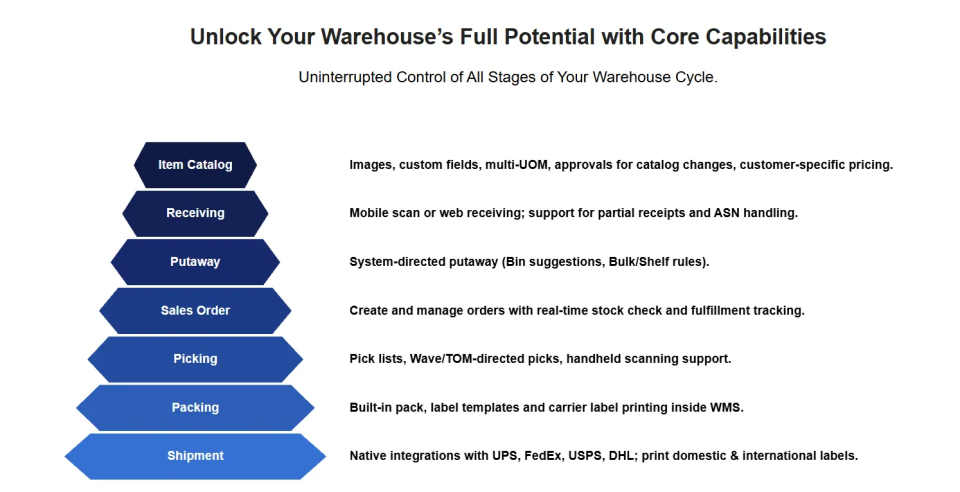
GOIS is a next-gen warehouse order and inventory management software that is designed to deliver real-time visibility, AI-powered demand forecasting and seamless automation for warehouse stock tracking in real-time.
Upgrade Your Warehouse with Smart Inventory Management
Get real-time visibility, AI-driven forecasting, and seamless automation with GOIS.
Request a DemoBeing integrated with existing supply chain systems and smart barcode scanners- it help reduces stockouts, improve order fulfilment process, and eliminate manual errors with powerful analytics dashboards. It comes with mobile scanning support to make it easily accessible anywhere, anytime.
Pros:
- Intelligent stock forecasting to prevent inventory distortion
- Bringing real-time visibility across multi-location and sales channels
- Strong automation & reporting capabilities
- Easy scalability for fastly growing enterprises
Cons:
- Custom pricing may not suit very small businesses
- Requires structured onboarding for complete optimization
2. Metaoption’s MetaWMS
Ideal for: Warehouses with complex operational needs
Pricing tier: Mid to high depending upon modular licensing
Rating: ★★★★☆
Setup Timeline: 3-6 weeks
MetaWMS is developed by MetaOption’s- a gold certified partner of Microsoft Dynamics 365 Business Central. It is a customizable warehouse control and inventory management solution that is crafted for flexible workflows, barcode/RFID handling, and multi-location agility.
Its modular design empowers businesses to tailor inventory rules, picking strategies, supplier sorting and UoM automatically depending upon the warehouse inventory needs.
Pros:
- Easy possibilities for modular customization
- RFID & barcode scanning compatibility
- Strong workflow configuration
- Suitable for complex warehouse setups
Cons:
- Requires configuration expertise
- Implemention time might be high with advanced modules
3. Oracle NetSuite WMS
Ideal for: Growing enterprises with ERP needs
Pricing tier: High
Rating: ★★★★☆
Setup Timeline: 6-10 weeks
Oracle NetSuite WMS is a globally recognized cloud-native warehouse system that offers real-time inventory visibility and allow you to keep a track of every movement of the stock.
Apart, it is designed to handle order management, and automate inventory tracking records – minimizing the scope of manual errors in inventory management.
The srong ERP integration, real-time data flows, and multi-site capabilities make NetSuite WMS a prime choice for fastly scaling businesses.
Pros:
- Deep ERP integration possible with NetSuite WMS
- Strong multi-warehouse management
- Cloud-native scalability and flexibility
Cons:
- Higher implementation cost
- Setup can be complex and costlier
4. Zoho Inventory
Ideal for: Small to medium e-commerce merchants
Pricing tier: Low-Mid
Rating: ★★★★☆
Setup Timeline: 1-2 weeks
Zoho Inventory is one such affordable yet powerful warehouse inventory management tool. It helps small and mid-size businesses manage stock, orders, and multi-channel sales all through a single platform. Leverage automated reorder points, batch tracking, and seamless integration with Zoho’s business suite- which sounds an excellent choice for ecommerce brands.
Pros:
- Affordable pricing tier
- Easy implementation and set up
- Good for small businesses
Cons:
- Limited scope for advanced warehouse automation
- Not ideal for large enterprise needs
5. Fishbowl Warehouse
Ideal for: SMB manufacturers and distributors
Pricing tier: Mid
Rating: ★★★★☆
Setup Timeline: 2-4 weeks
It one of the highly rated and best warehouse inventory management software solutions for manufacturing and distribution operations. Considering the changing needs of the manufacturer and distributors, Fishbowl has designed to offer barcode support, automatic reorder alerts, and strong QuickBooks integration to optimize inventory and reduce carrying costs.
Pros:
- Strong integration with manufacturing tools
- Reliable inventory tracking and visibility
- Good QuickBooks compatibility
Cons:
- UI of Fishbowl is little complex and dated
- Limited advanced analytics
6. SkuVault
Ideal for: Retailers with omni-channel needs
Pricing tier: Mid
Rating: ★★★★☆
Setup Timeline: 2-5 weeks
SkuVault specializes in inventory accuracy and omni-channel fulfillment by linking online channels with warehouse operations. It supports cycle counting, batch picking, and analytics to increase order precision.
Pros:
- Strong omni-channel sync
- Improves inventory accuracy
- User-friendly interface
Cons:
- Pricing may increase with growth
- Limited ERP depth
7. SAP Extended Warehouse Management (EWM)
Ideal for: Large enterprises & global logistics
Pricing tier: Very high
Rating: ★★★★★
Setup Timeline: 10-16+ weeks
Enterprise-grade warehouse automation with advanced tasking, labor management, and real-time stock visibility. SAP EWM is suited for global operations requiring deep process automation and compliance.
Pros:
- Enterprise-level automation
- Deep supply chain integration
- Global scalability
Cons:
- Very high implementation cost
- Long deployment timeline
8. Cin7 Core
Ideal for: Retailers & distribution businesses
Pricing tier: Mid
Rating: ★★★★☆
Setup Timeline: 3-5 weeks
A unified platform combining inventory, POS, and order management — ideal for businesses scaling across retail and distribution. Cin7 delivers real-time stock updates and multi-location sync.
Pros:
- Multi-channel integration
- Strong reporting tools
- Balanced pricing
Cons:
- Advanced customization limited
- Can become costly at scale
9. QuickBooks Commerce
Ideal for: Small inventory operations & QuickBooks users
Pricing tier: Low-Mid
Rating: ★★★★☆
Setup Timeline: 1-3 weeks
Best for small operations already using QuickBooks ecosystem. Simplified stock control, demand alerts, and sales channel integration help small teams reduce manual work.
Pros:
- Easy QuickBooks integration
- Simple interface
- Fast deployment
Cons:
- Limited warehouse depth
- Not ideal for multi-warehouse complexity
10. Odoo Inventory
Ideal for: Customizable, open-source adopters
Pricing tier: Low-Mid
Rating: ★★★★☆
Setup Timeline: 2-6 weeks
Open-source ERP with core warehouse features like automated replenishment, multi-warehouse support, and packaging control. Highly extensible with other Odoo business apps.
Pros:
- Open-source flexibility
- ERP expansion capability
- Affordable entry cost
Cons:
- Requires technical setup
- Advanced features need add-ons
Quick Comparison Between Best Warehouse Inventory Management Software
When it comes to choosing the best warehouse inventory software in 2026- leaders are not looking for the software that is heavily loaded with top features and automations. Rather, they want a solution that align with their unique warehouse and inventory management challenges.
Top enterprise solutions like GOIS, MetaWMS and SAP EWM are designed to deliver deep automation and scale, while platforms like Zoho Inventory and QuickBooks Commerce are ideal for smaller operations.
| Solution | Best Use Case | Price Tier | Set-Up Time | Rating |
|---|---|---|---|---|
| GOIS | Enterprise AI + automation | High | 4–8 weeks | ★★★★★ |
| MetaWMS | Customizable workflows | Mid–High | 3–6 weeks | ★★★★☆ |
| Oracle NetSuite WMS | Integrated ERP | High | 6–10 weeks | ★★★★☆ |
| Zoho Inventory | SMB e-commerce | Low–Mid | 1–2 weeks | ★★★★☆ |
| Fishbowl Warehouse | Distribution | Mid | 2–4 weeks | ★★★★☆ |
| SkuVault | Omni-channel retail | Mid | 2–5 weeks | ★★★★☆ |
| SAP EWM | Global logistics | Very High | 10–16+ wks | ★★★★★ |
| Cin7 Core | Retail + Distribution | Mid | 3–5 weeks | ★★★★☆ |
| QuickBooks Commerce | QuickBooks users | Low–Mid | 1–3 weeks | ★★★★☆ |
| Odoo Inventory | Open-source flexible | Low–Mid | 2–6 weeks | ★★★★☆ |
Final Words
At the end of this blog, this is fair enough to say that there is no winner or loser in this list. All the listed solutions are top market performers but choosing the best warehouse inventory management software often depends on your business size, budget, and operational complexity.
Some of the software solutions like GOIS and adaptable systems like Metaoption’s MetaWMS stand out for automation and scalability. Meanwhile, solutions such as Zoho Inventory or SkuVault can deliver solid performance for SMBs or multi-channel sellers with shorter rollout times. All you need to do is to deeply evaluate your inventory tracking requirements and future growth plans to make a wise choice.
Frequently Asked Questions (FAQ’s)
1. What is warehouse inventory management software?
It’s a system that tracks stock levels, locations, movements, and orders within a warehouse, enhancing accuracy, reducing losses, and automating tasks.
2. How do I choose the right inventory management system for warehouse operations?
Evaluate your business size, budget, integration needs (ERP/e-commerce), reporting requirements, and whether automation or customization is a priority.
3. What features are essential in the best warehouse inventory management software?
Core features include real-time inventory tracking, barcode/RFID scanning, automated replenishment, reporting/analytics, and integration with existing systems.
4. Can small businesses benefit from advanced warehouse systems?
Yes, many platforms like Zoho Inventory, QuickBooks Commerce, and Odoo offer scaled-down features suited to smaller operations.
5. How long does implementation usually take?
Implementation timelines range from a few days for simple systems to several weeks or months for enterprise solutions with complex integrations.

Naushad Ahmed 
Naushad Ahmed is a technology expert at Goods Order Inventory (GOIS) specializing in inventory management, order fulfillment, and warehouse operations for small and mid-sized businesses. He shares practical insights on inventory control, stock accuracy, automation, and multi-location management to help businesses move beyond spreadsheets, reduce stockouts and overstock, and scale their operations efficiently.