Holiday season sales are already geared up. The peak season of the year has hit the market. But are you still losing the revenue?
If yes, then it’s high time to realise, the holiday rush of 2026 won’t be just about offering bigger discounts and faster deliveries- it will be about precision.
As per recent retail reports, over 35% of global retailers started losing revenue even during the peak holiday season. Reason- due to poor inventory visibility!
This is where your spreadsheets or basic inventory tracking systems started collapsing. You keep trying to extract the inventory numbers and making it matched with your warehouse stock, and meanwhile, competitors will grab the biggest opportunity of the year.
Did you know stockouts alone account for nearly $1.9 trillion in lost sales annually?
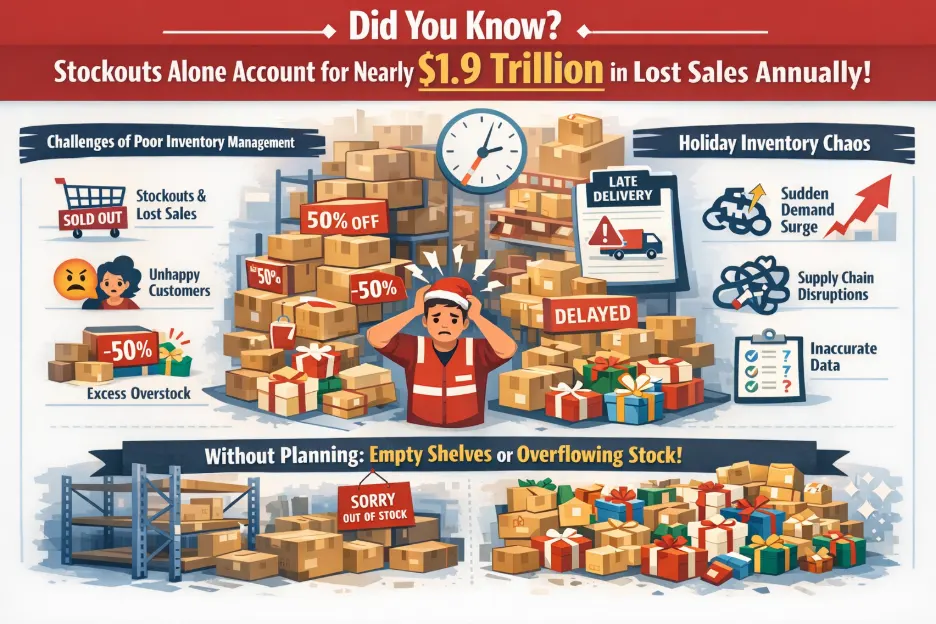
Why Does a Holiday Inventory Management Checklist Matter In 2026?
Consider this:
- 73% of consumers switch brands immediately if a product is out of stock.
- 1 in every 4 holiday orders is abandoned due to the unavailability of inventory or delayed delivery.
- Retailers with poor inventory planning and management lose up to 10% of annual revenue.
So what’s the catch here? It’s time to understand that product demands no longer build gradually- its pikes without warning, driven by flash sales, social media trends, and AI-powered product recommendations that can make products viral overnight.
Ecommerce brands needs inventory strategy that is:
- Adaptive to real-time demand shifts
- Built for Omnichannel fulfilment
- Capable of accommodating a sudden demand rise without overstocking
Without a structured holiday inventory management checklist can save you from facing the worst face of empty shelves during high-demand days and excessive stocks once the season ends.
Holiday Peak Season 2026: What’s Changing?
Before diving into the holiday inventory management checklist, let’s understand what makes holiday season inventory planning in 2026 uniquely challenging:
- AI-driven buying behavior, which means demand spikes can happen overnight.
- Omnichannel fulfillment, which includes online, store pickup, and dark stores, adds to the complexity of inventory management.
- Global supply chains during the holiday season remain unpredictable, with fluctuating lead times.
- Sustainability pressures are forcing ecommerce brands to leaner, smarter stocking models.
Retailers that win in 2026 won’t just stock more; they’ll stock smarter and manage it intelligently to avoid storing excessive stock and having empty shelves during peak time.
The Ultimate Holiday Inventory Management Checklist for 2026
Here’s how you can plan inventory before the peak season starts spiraling the inventory…
1. Start Planning Before the Season Starts
If you’re planning inventory in October, you’re already late. Top-performing ecommerce companies start their inventory and warehousing management planning atleast before 4 to 6 months in advance.
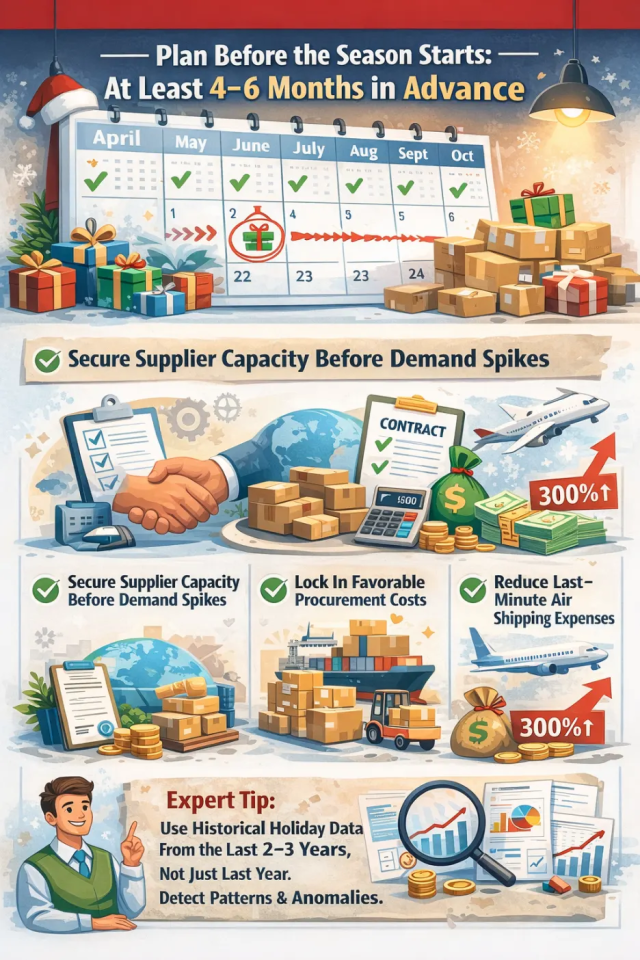
This is what early planning rewards you with:
- Secure supplier capacity before demand spikes
- Lock in favourable procurement costs
- Reduce last-minute air shipping expenses, which can increase logistics costs by up to 300%
Expert Tip: For efficient inventory planning, use historical holiday data from the last 2-3 years, not just last year. It helps you detect patterns and anomalies.
2. Leverage the Demand Forecasting Feature For Real-Data
Guesswork doesn’t always work in the same way as you think during peak season.
The uncertain fluctuating consumer needs can turn holiday inventory management into complex system. Demand forecasting relies on:
- Historical sales trends
- Seasonal demand patterns
- Promotional calendars
- Market signals such as search trends
Retailers using AI-driven demand forecasting report up to 25% lower inventory holding costs and 15-20% fewer stockouts during peak season.
3. Reset SKUs Based on Holiday Sale Performance
Not every product on your shelve deserves equal attention. Break your inventory into clear categories:
- Priorities the holiday best-seller of fast-moving items.
- Using SKUs that are Seasonal-only
- Slow movers with promotional potential
- Pay attention to high-margin gift items
This SKU-level segmentation allows you to:
- Prioritize reordering of hot-selling products before it stockout
- Using warehouse space efficiently
- Avoid capital getting stuck in low-velocity items
4. Make a Strong Collaboration With Supplier
Holiday inventory management wont be possible without strong supplier partnership. Peak season exposes weak supplier relationships instantly. To stabilize holiday season inventory management:
- Share demand forecasts atleast 4-5 months before the holiday season
- Always confirm production capacity and lead times in writing
- Keep a backup suppliers for critical SKUs to meet seasonal sale demand
Retailers with reliable and proactive supplier coordination experience 30% fewer fulfillment disruptions especially during peak time of the season.
5. Create a Stock-Backup in a Strategic Way
Safety stock isn’t about hoarding, it’s about buffering risk. In 2026, smart holiday inventory management checklist should includes safety stock planning, by considering:
- Demand volatility by SKU
- Supplier reliability
- Transit time variability
Overstocking can suddenly increase the carrying costs by 20-30%, while understocking directly impacts customer satisfaction scores. So what’s the trick?
The key is dynamic safety stock that need to be adjusted weekly based on real-time sales velocity instead of stocking up in one go.
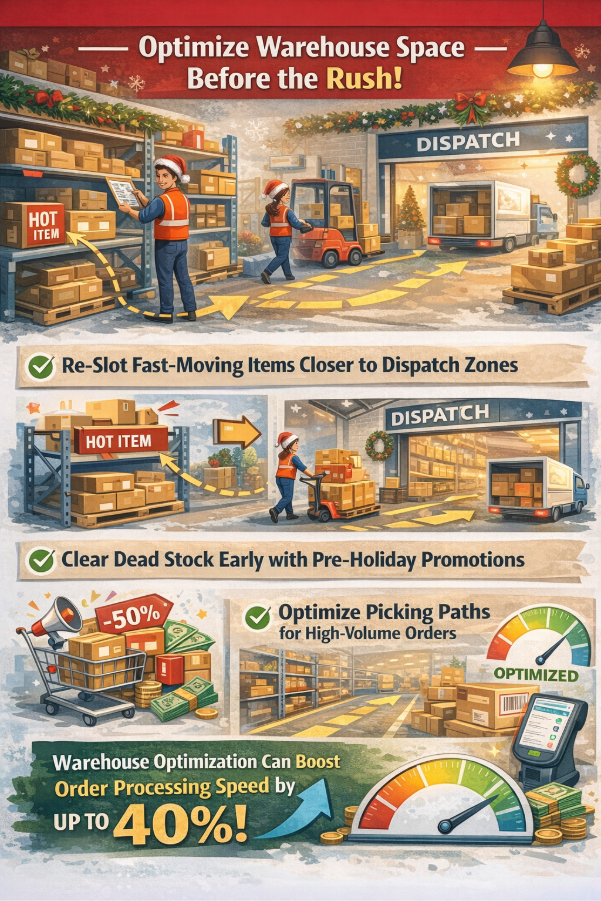
6. Optimize Warehouse Space Before the Rush to Order Products
Holiday inventory doesn’t just need products, it needs room to move. So plan it by deeply optimizing the warehouse space or start moving the products over shelves.
Before peak season hits:
- Re-slot fast-moving items closer to dispatch zones
- Clear dead stock early with pre-holiday promotions
- Optimize picking paths for high-volume orders
Warehouse optimization alone can improve order processing speed by up to 40% during peak demand, so it can’t be skipped from your holiday inventory management checklist in 2026.
7. Extract Real-Time Inventory Visibility
Always keep in mind, blind inventory is expensive inventory. Inaccurate stock data leads to:
- Overselling
- Order cancellations
- Customer service overload
This is where extracting the real-time inventory visibility of your stock across all channels ensures:
- Accurate product availability
- Faster fulfillment decisions
- Seamless omnichannel operations
Retailers with unified inventory visibility see up to 35% improvement in order fulfillment accuracy during the holiday season.
8. Prepare for Flash Sales & Product Spikes
Holiday promotions don’t follow predictable curves during seasonal sale. Flash sales, influencer drops, and social commerce campaigns can create sudden demand surges of up to 200-400% within hours.
So, how to prepare well in advance?
- Pre-allocate inventory for planned campaigns
- Set reorder triggers for promotional SKUs
- Monitor sales velocity in real time
Preparing yourself in advance is the core pillar of effective holiday season inventory planning.
9. Be Prepared and Plan for Reverse Logistics in Advance
As seasonal sale give spiked to order, it can be equal spiked in order returns as well after the holidays.
In fact, holiday returns are 25-30% higher than regular season returns, especially in ecommerce. So make sure, your holiday inventory management checklist should plan for return orders by:
- Dedicatedly allocating space for returned goods
- Clear grading rules like restock, refurbish, liquidate
- Fast reintegration of return orders into sellable inventory
Efficient reverse logistics can recover up to 65% of product value post-holiday and save you
10. Align Inventory Management With Fulfillment Strategy
Where your inventory sits matters as much as how much you have. Think of this, dispatching the product from the warehouse, can increase logistics cost, causing delays and may be customer abandon the product meanwhile.
In 2026, distributed fulfillment is no longer optional, therefore you need align inventory with:
- Regional warehouses
- Micro-fulfillment centres
- Store-based fulfillment
Strategic placement of inventory help minimizing the:
- Delivery times
- Last-mile costs
- Customer complaints
Brands with optimized inventory distribution reduce fulfillment costs by 18–22% during peak season and able to cater customer demand even before the expected timelines.
11. Monitor Inventory KPIs-Daily, Not Weekly
Peak season doesn’t wait for weekly reports, it needs immediate action if you really want to grab the holiday sales opportunity.
So while preparing the holiday inventory management checklist in 2026, track these metrics daily:
- Pattern of inventory turnover
- Sell-through rate
- Stockout or reordering frequency
- Days of inventory on hand
Real-time KPI tracking enables quick course correction before small issues turn into revenue losses.
12. Prepare a Post-Holiday Inventory Exit Plan
Holiday success isn’t just about December; it’s about January too. You might still have inventory left on hand for sale. It’s time to clear that also.
Smart holiday inventory management includes:
- Planned markdown schedules
- Bundle offers for leftover stock
- Liquidation channels identified in advance
Retailers with pre-defined exit strategies clear excess inventory 40% faster, protecting cash flow and warehouse space.
Final Thoughts: Winning the Holiday Season Starts With Inventory Management Checklist
With the end of this blog, you probably got an idea about how peak season sale can reward brands by simply managing the inventory rightly. Inventory management checklist can double your holiday sales by enabling you to strategically move the inventory.
A well-executed holiday inventory management checklist ensures:
- Fewer stockouts
- Higher order fulfillment rates
- Better customer experiences
- Stronger profit margins
- Quicker deliveries even during high time
With demand volatility increasing and customer patience shrinking. This is where holiday season inventory planning turn out to be a biggest saviour. It the difference between seasonal success and post-holiday regret. Plan early. Monitor constantly. Execute intelligently because in 2026, the brands that control inventory will be going to experience best sales.

Naushad Ahmed 
Naushad Ahmed is a technology expert at Goods Order Inventory (GOIS) specializing in inventory management, order fulfillment, and warehouse operations for small and mid-sized businesses. He shares practical insights on inventory control, stock accuracy, automation, and multi-location management to help businesses move beyond spreadsheets, reduce stockouts and overstock, and scale their operations efficiently.