
Well, if not yet, then you need to understand that 35% of businesses know that their inventory processes are inefficient but still they continue using outdated tools or spreadsheets.
If you are still waiting to migrate from traditional systems and believe in those inventory management myths then you might be one of these:
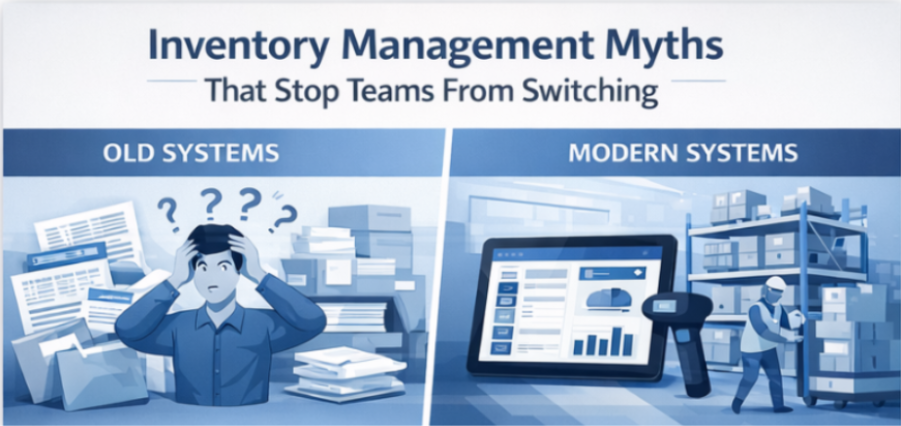
Market stats and facts of traditional inventory management systems:
- According to Gartner, poor inventory visibility can increase operational costs by 10 to 20% due to stock inaccuracies and inefficient purchasing decisions.
- According to Myos, 63% of retail operations are inaccurate in the US due to a lack of proper inventory management.
- 43% of small businesses fail to monitor their inventory.
McKinsey & Company shows that companies that adopt digital inventory management solutions can improve inventory accuracy by up to 30% and reduce stockouts significantly.
Despite realizing these benefits, many organizations hesitate to switch systems. Why?
Because inventory management myths create unnecessary fear around implementation, and especially data migration myths. Teams worry about disruption, data loss, or long implementation timelines.
In reality, modern inventory management systems are crafted to simplify transitions smoother and secure.
This blog will help you understand the common inventory management myths that prevent companies from upgrading.
Most Common Inventory Management Myths Holding Your Success and Scalability
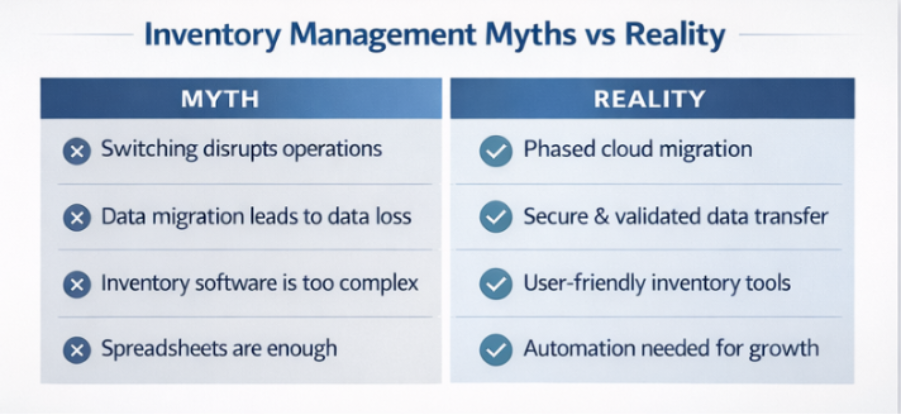
Myth 1: Switching Inventory Systems Seems Too Complicated
One of the most common inventory management myths is that migrating to a new system will halt operations for weeks.
Reality is that modern inventory solutions like GOIS next-gen inventory management solutions are designed for phased implementation. This means businesses can migrate data, configure workflows, and train teams without disrupting their regular operations.
Since this is a cloud-based platform, it reduces installation complexity and minimize downtime. Most companies find that the transition is far smoother than expected.
Myth 2: High Risk of Data Loss During Migration
Data is everything in inventory management. Many businesses fear losing years of inventory records, supplier data, or transaction history. This concern is often fueled by data migration myths.
Reality is that today’s inventory systems include structured migration processes that involve:
- Data audits
- Data mapping
- Automated imports
- Validation and testing
Most trusted inventory management software partners performed migration in stages to ensure accuracy. Backup copies and verification steps protect historical records.
In most cases, switching systems actually improves data quality by removing duplicates and outdated entries.
Myth 3: Assuming That Team Will Struggle to Learn the New System
Another common inventory management myth is that employees will resist or struggle to adapt to new technology.
Reality is modern inventory platforms are designed by keeping in mind user-friendly interfaces that are far simple to navigate and easy to access.
Features such as dashboards, barcode scanning, and automated alerts simplify daily workflows. Training programs, onboarding support, and intuitive design help teams adopt the system quickly.
In many organizations, employees report less manual work and fewer repetitive tasks after implementation.
Myth 4: Large Enterprises Are Only Using Inventory Software
Small and mid-sized companies usually assume that these inventory management systems are meant only for large enterprises to handle complex operations.
Reality is that inventory management platforms are designed for all sizes of businesses.
The new-era cloud-based solutions allow companies to start with critical features and easily expand as operations grow.
Further, as far as it’s pricings and costings are concerned, most solutions come with Subscription-based pricing models which are easily accessible for the small to mid-sized businesses. There is no expensive upfront investments required.
Myth 5: Spreadsheets Are Still Good Enough to Operate With
Many teams continue relying on spreadsheets because they appear simple and familiar. But this belief is one of the most horrible inventory management myths which actually drains your efficiency and put the entire data at risk.
Reality is spreadsheets quickly become unreliable when operations scale. The major problems aligned with this includes:
- Handling multiple file versions
- Manual entry errors
- Lack of real-time updates
- Limited reporting capabilities
Inventory software centralizes all inventory data in a single system, allowing teams to track stock levels, orders, and supplier activity in real time.
Myth 6: Implementation Of New Inventory System Will Takes Too Long
Some businesses believe inventory system implementation can take months or even years and keep the business operations on risk.
Reality is with cloud-based solutions and pre-built integrations, many inventory systems are faster to implement and enables you get started immediately without any need of coding.
The timeline usually depends on factors such as:
- Data complexity
- Number of locations
- Integration with other systems
Even with these factors, modern implementations are far faster than traditional ERP deployments.
The Real Benefits of Upgrading Inventory Systems
Once companies move beyond these inventory management myths, they often see immediate operational improvements.
The core benefits of transiting to modern inventory management systems are:
- Real-time inventory visibility across locations
- Automated stock tracking and alerts
- Improved demand forecasting
- Faster order fulfillment
- Better purchasing decisions
- Reduced carrying costs
By replacing manual workflows with automation, businesses gain accuracy, speed, and better operational control.
How to Overcome Data Migration Concerns
Concerns around data migration myths often disappear once teams understand the structured or strategic migration process. A typical inventory management system migration process includes:
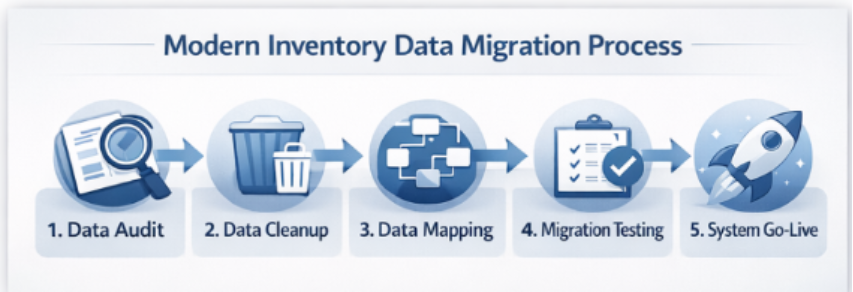
- Inventory Data Assessment: Instead of randomly starting to migrate the data, experts review the existing data to ensure accuracy and completeness.
- Data Cleanup and Standardization: Using AI-Driven workflows, experts remove duplicates and outdated records.
- Mapping Data to the New System: To meet perfection, experts align the existing data with the new system platform’s structure to avoid data distortion.
- Testing and Validation: Before delivering the system, experts conduct multiple tests to ensure that all data records transfer correctly.
- Go-Live and Monitoring: Monitoring system performance during the transition.
This structured approach ensures minimal risk and a smoother transition.
Crucial Signs Your Business Should Move Past Inventory Myths
If you are not recognizing when is the best time to migrate from traditional inventory systems, then pay attention if you are experiencing the following challenges. It may be time to move beyond inventory management myths and consider upgrading, if
- There is inventory discrepancies between systems
- An increasing number of hours spent manually updating spreadsheets
- Difficulty forecasting demand or still assumptions are used to predict future-demands
- Slow order fulfillment or delays happen
- Limited visibility across warehouses
Final Words
Many companies delay upgrading their systems because of all those common inventory management myths and concerns fueled by outdated experiences.
However, modern inventory platforms are designed to simplify implementation, protect data during migration, and improve operational efficiency.
The next-gen inventory management system, like GOIS are designed beyond these misconceptions, especially data migration myths. Businesses adopting GOIS are experiencing seamless data migration, extracting real-time visibility of operations and automated workflows.
If you are still in doubt that how inventory system migration help you or what operations you can upgrade with these new-age systems, then contact to our experts.
FAQs
What are the most common inventory management myths?
Some of the most common inventory management myths include beliefs that switching systems causes operational disruption, data migration leads to data loss, and inventory software is only suitable for large enterprises.
Is data migration risky when switching inventory systems?
Modern platforms follow structured migration processes with data validation, backups, and testing. These steps address common data migration myths and ensure accurate data transfer.
Can small businesses use inventory management software?
Yes. Many cloud-based inventory solutions are designed specifically for small and mid-sized businesses with scalable pricing and modular features.
How long does inventory system implementation take?
Implementation timelines vary, but many modern inventory systems can be deployed within a few weeks depending on data complexity and integrations.

Naushad Ahmed 
Naushad Ahmed is a technology expert at Goods Order Inventory (GOIS) specializing in inventory management, order fulfillment, and warehouse operations for small and mid-sized businesses. He shares practical insights on inventory control, stock accuracy, automation, and multi-location management to help businesses move beyond spreadsheets, reduce stockouts and overstock, and scale their operations efficiently.