
The global retail industry has suffered to loss of $1.77 trillion, despite even spending billions in improvements. The empty shelves or inventory distortion make them lose approx. $349 billion in sales.
Another report says that around 20-30% of potential ecommerce sales are lost due to stockouts, and up to 69% of shoppers will abandon a purchase and buy elsewhere of an item is unavailable.
Many businesses lock up 20-30% of their total assets in inventory that sits idle, eroding cash flow and limiting growth.
If you’re constantly fighting against stockouts, dealing with dead inventory, reconciling mismatched reports manually and struggling to discover fulfillment errors after customer complaints, then keep in mind that your inventory operations aren’t just inefficient; they are drastically leaking revenue daily.
Because.
- Your working capital is locked in excess stock that is lying on the shelves.
- Sales are lost due to inaccurate availability, or showing either stockout or overstocking.
- Margins are drastically shrinking because of emergency replenishment.
- Financial teams are not trusting the numbers, and operational teams are relying on spreadsheets to fix the system gaps.
This is where modern inventory management is no longer optional optimization; it is a control mechanism for profitability, scalability, and financial accuracy.
Take Control of Profit with Smarter Inventory
Stop losing money to inefficiencies. Switch to a smarter inventory system today!
Let’s address the exact operational breakdowns that are driving this complexity and what exactly it takes to fix them.
Operational Pain Areas of Modern Inventory Management
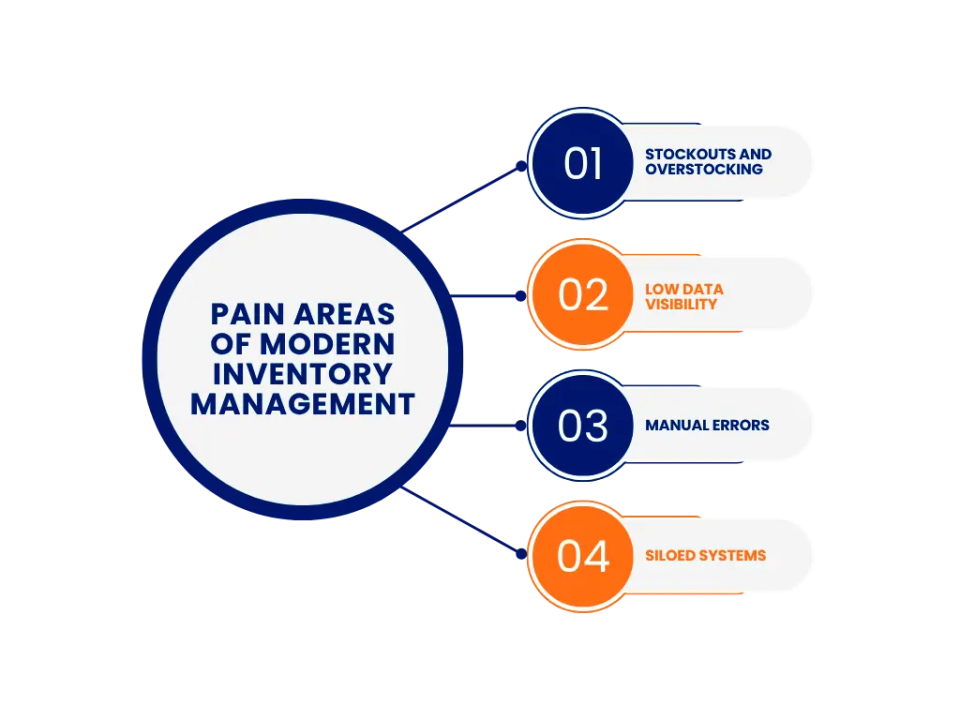
1. Stockouts and Overstocking: Causing a Straight Impact on Margins
Poor demand planning and reactive purchasing always to financial damage and creates a constant imbalance. The direct impacts you can notice:
- Stockouts lead to major sales losses
- Constantly paying higher expedited shipping costs for urgent replenishment
- Excess inventory is staying idling on the shelves.
- Take a note from obsolete or slow-moving stock
In a retail or ecommerce business, inventory is cash. When it sits too long, it controls the growth. When it runs out, your revenue quickly disappears.
Modern inventory management requires predictive forecasting, automated replenishment triggers, and real-time demand synchronization across channels.
2. Low Data Visibility Across Locations
If you are using manual procedures to update the data and doing it at the end of the day, and keeping it on disconnected systems- then leaders are forced to make decisions based on outdated information.
If you are taking it lightly, then think it with the bigger picture. In multi-location operations, this leads to:
- Poor inventory transfer decision between warehouses.
- No action on hidden dead stock
- Lack of inventory alignment and fulfillment planning
- Inaccurate availability displayed to customers
Without centralized, real-time visibility, inventory control becomes reactive and inefficient.
3. Manual Errors Leading To Blunders While Scaling With Growth
Even digitally enabled businesses often rely on manual touchpoints like:
- Using and uploading spreadsheets for data gathering
- Manually adjusting the inventory stock
- Discrepancies during cycle count
- Incorrect SKU entries
- Picking and packing mistakes
Every manual intervention in data recording increases the risk of errors. At scale, small errors that can be easily detected but while you are scaling, the same issues or errors cause a direct impact on profitability, fulfillment speed, and customer satisfaction.
Modern inventory management demands automation at critical checkpoints to reduce dependency on human error.
4. Siloed Systems Often Create Operational Friction
No inventory system can work independently. Inventory data is most powerful when connected with sales systems, purchasing workflows, warehouse operations, and financial reporting.
Without seamless integration, businesses face:
- Double-selling of items
- Duplicate data entry
- Delayed purchase orders
- Financial discrepancies
- Process bottlenecks
Inventory cannot function effectively in isolation. It must be embedded into a unified operational ecosystem that helps you get a big picture of the inventory and enables you make a powerful decision.
How GOIS Solves Modern Inventory Management Complexity?
GOIS’s order and inventory management system is designed to overcome these operational challenges and empower businesses with the functionalities to move more strategically.
To deal with modern inventory challenges, businesses need more than software – they need structured, integrated control.
GOIS helps organizations transition from reactive inventory tracking to strategic inventory intelligence through:
1. Providing Real-Time Data Update
- Inventory updates are happening over a centralized dashboard across locations.
- Live stock movement tracking, to help you understand where and what inventory is stored.
- Automated alerts for stock levels to prevent overstocking and stockout situations.
2. AI-driven Demand Planning and Forecasting
- Data-driven forecasting and removing assumptions based on order planning
- Automated replenishment logic by deeply analyzing the inventory patterns
- Seasonal and trend-based adjustments in the system
3. Frictionless System Integration
- The GOIS system ensures bi-directional sync between sales, purchasing, and finance
- Reduced manual data entry as all the inventory movements are constantly updated in the system
- Accurate inventory valuation in financial reports
4. Automation to Reduce Human Error
- Barcode scanning-enabled processes
- Controlled approval workflows
- Automated stock adjustments and transfers
5. Scalable Infrastructure
- Supports multi-location operations
- Handles SKU growth without system breakdown
- Designed for expanding businesses
GOIS transforms inventory from an operational burden into a controlled, structured and measurable growth driver.
Final Words
With this blog, hopefully you understand that how inventory management complexity can be tenfold when there is a lack of structured system. The modern inventory management is no longer a warehouse management option, but an essential need.
The right choice of inventory management solution will directly impacts on working capital utilization, profit margins, fulfilment performance, audit readiness and scalability.
Businesses that modernize inventory management gain operational predictability and financial clarity. Those that delay modernization face compounding inefficiencies.
Frequently Asked Questions (FAQ’s)
What is modern inventory management?
Modern inventory management refers to the well structured approach of managing inventory where warehouses are using real-time data visibility, technology-driven approach to tracking, forecasting, and controlling inventory across multiple locations and sales channels.
Why is modern inventory management becoming more complex?
As the order volumes and SKUs are increasing with time, the complexity of managing inventory increases. Moreover, due to multi-channel sales, multi-warehouse operations, growing SKU variations, faster customer expectations, and changing demand patterns- traditional tracking systems failing to handle and scale.
How does poor inventory visibility impact business performance?
Limited visibility leads to stockouts, excess inventory, inaccurate financial reporting, poor transfer decisions, and lost sales—ultimately impacting cash flow and profitability.
How can automation improve inventory accuracy?
Automation reduces manual data entry, prevents counting errors, enables barcode-based tracking, and ensures real-time stock updates—significantly lowering discrepancy rates.
Why is system integration critical in inventory management?
Integrated systems ensure inventory data flows seamlessly between sales, purchasing, and finance. This prevents double-selling, reduces process delays, and maintains accurate financial reporting.

Naushad Ahmed 
Naushad Ahmed is a technology expert at Goods Order Inventory (GOIS) specializing in inventory management, order fulfillment, and warehouse operations for small and mid-sized businesses. He shares practical insights on inventory control, stock accuracy, automation, and multi-location management to help businesses move beyond spreadsheets, reduce stockouts and overstock, and scale their operations efficiently.