Are you also looking for the top inventory management trends in 2026 that may simplify your inventory tracking process?
If you are in hunt of top logistics Trends in 2026, then keep in mind that they are no longer just about tracking what’s sitting on shelves.
With lots of emerging trends boldly entering the inventory and warehouse management industry, they’re about predicting demand shifts, preventing revenue leakage, and enabling you make profit-driven decisions in real time.
If your business is still juggling with stockouts, excessive inventory, delayed fulfillment, or disconnected systems, you’re not alone.
Industry data shows that retailers lose billions every year due to poor inventory visibility, while manufacturers continue to absorb rising costs caused by demand volatility. And above all, supply chain disruptions also added to these losses.
With the aggressively changing requirements of customers, the gap between demand and control over inventory is constantly increasing. It is forcing businesses to rethink how inventory is planned, stored, monitored, and optimized.
This is where digging deep to top inventory management trends in 2026 will be a logical decision. Here in this blog, along with these top trends, will make you understand why inventory management has become a critical function. And how GOIS (Goods Order Inventory System) like platforms are adopting companies these trends.
Let’s start with the basics…
What Is Inventory Management?
Inventory management is a systematic process of tracking, controlling, and optimizing stock levels across the supply chain. Right from procurement and storage to order fulfilment and delivery- inventory management systems are playing a major role.
But in 2026, inventory management systems will no longer rely on manual or spreadsheet-driven processes. Businesses are realizing the gap and shifting to Modern inventory management systems, that:
- Track inventory in real time
- Forecast demand using data and analytics
- Automate reordering and stock optimization
- Integrate seamlessly with sales, procurement, and logistics
In short, automated inventory management systems ensure you always have the right product, at the right place, at the right time- without blocking capital or losing customers.
Here you can check how inventory management systems work.
Why Is Inventory Management Important in 2026?
The stakes have never been higher. In 2026, as the customer demands are becoming complex and unpredictable, businesses are expected to deal with:
- Unpredictable demand cycles
- Faster delivery expectations
- Complex to strike a balance between demands and orders
- Difficulty in handling Multi-channel selling with multiple tools
- Dealing with global uncertainties
Poor inventory management directly leads to:
- Heavy loss in sales due to stockouts
- Cash flow issues from overstocking
- Expensive warehousing costs due to overstock storage
- Delayed order fulfillment
- Unsatisfied customers who don’t return
On the other hand, organizations choosing to partner with top inventory management systems to meet their modern inventory management needs report:
- Up to 30% reduction in inventory holding costs
- Faster order fulfillment
- Improved demand accuracy
- Better supplier coordination
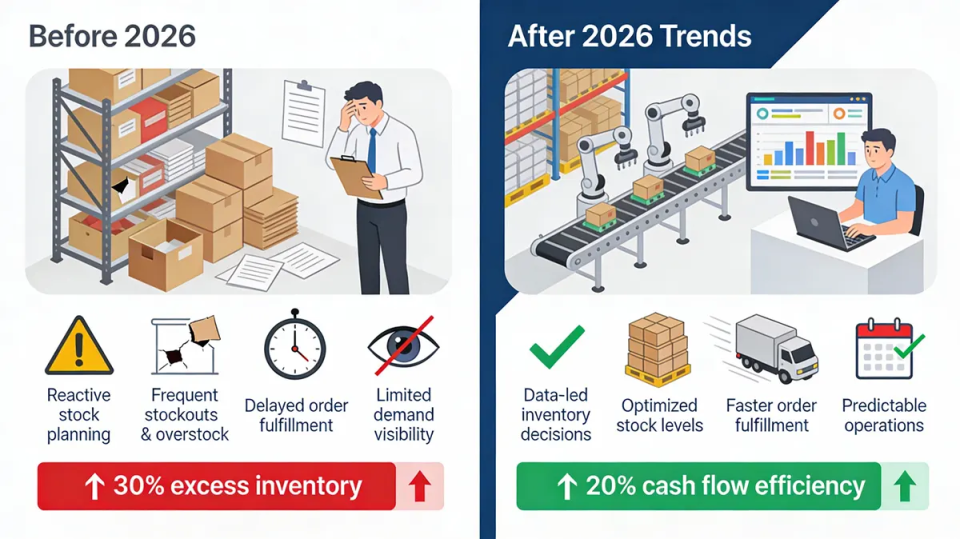
This is why inventory management is no longer a back-office task, it’s a strategic business move in 2026.
Top Inventory Management Trends in 2026
No matter how big or small level of inventories you are managing. Some of the latest trends in inventory management are focused on automation, AI intelligence, blockchain, and more. Businesses that adopt these trends early will scale more quickly, get better control over inventory, and remain competitive.
Let’s explore the top inventory and warehouse management trends that will shape 2026
1. AI-Powered Demand Forecasting That Reduces Guesswork
In 2026, businesses will no longer use just historical sales to predict future demands.
Smart businesses will cut the guesswork with AI-driven inventory forecasting tools that provide deep insights on sales patterns, their velocity, seasonal demand, promotions, supplier lead times, and market signals—all at once.
With this, businesses can prepare before demand spikes, instead of panicking after the stock runs out.
What this helps businesses achieve:
- Less risk of stockouts during high-demand periods
- Lowering the scope of storing excess inventory during slow seasons
- Better purchasing decisions with less capital locked up
This trend shifts inventory planning from assumption-based order filling to data-backed inventory movement.
2. Extracting Real-Time Inventory Visibility At Multi-Location Warehouses
Have you ever dealt with a situation where your spreadsheets show goods in stock, but when it comes to delivery, there is no stock available?
If yes, then it’s time to adopt a new inventory management trend in 2026!
Businesses operating across multiple warehouses, stores, or fulfillment centers often don’t know where their stock actually is and in what quantity.
Next-Gen Cloud Inventory Management Software are remapped with the latest trends and provide businesses with real-time visibility as every unit is tracked, updated, and accessible instantly. No matter how many warehouses, locations, or storage spaces are being usedg integrated with the system.
What this helps businesses fix:
- No more selling items that aren’t available
- Faster order routing from the nearest location
- Reduced internal confusion between teams
- Saving operational cost with optimized routing
In 2026, real-time stock visibility isn’t a feature; it’s a business survival requirement.
3. Preventing Stock Gaps with Automated Replenishment
Manual reordering leads to late purchases, emergency buying, and higher supplier costs.
Automated replenishment systems monitor stock thresholds and trigger purchase orders at the right time, based on demand trends and supplier timelines.
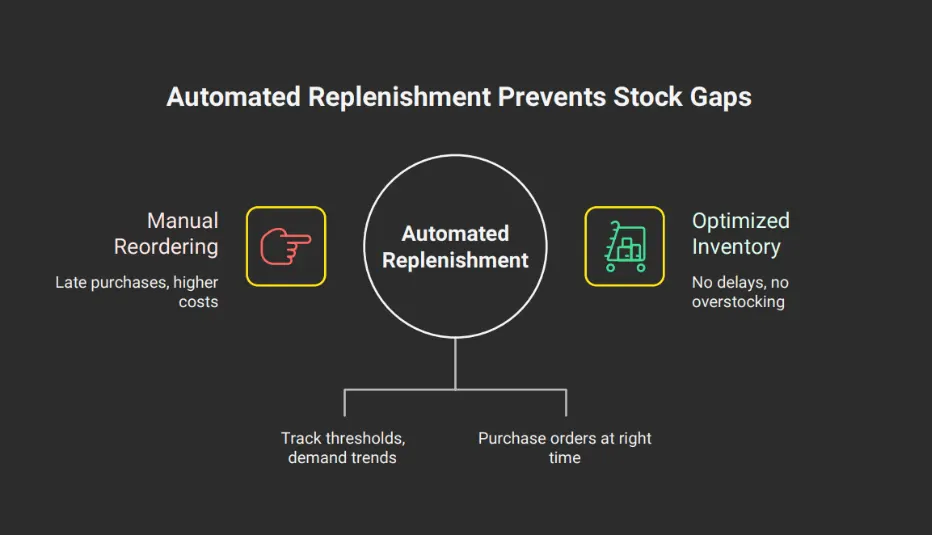
What this helps businesses avoid:
- Last-minute procurement decisions
- Production delays due to missing materials
- Overstocking caused by bulk panic buying
This trend ensures inventory flows consistently, not randomly.
4. Integration-First Inventory Systems
Did you know, 73% of US companies are struggling with system integration failures? Disconnected systems slow everything down.
In 2026, look forward to integrating top inventory tools like GOIS, built to sync seamlessly with sales platforms, ERP systems, accounting software, and logistics tools.

What this helps businesses improve:
- Accurate stock data across all departments
- Faster order processing
- Clear financial forecasting tied directly to inventory
When systems talk to each other, decisions become faster and cleaner.
5. Smart Inventory Planning with Data-Based Prediction
In 2026, say goodbye to guesswork completely. Supply chain disruptions aren’t exceptions anymore; they’re expected.
Predictive inventory planning uses trend analysis and risk indicators to identify future shortages, supplier delays, or demand surges before they impact operations.
What this helps businesses stay ahead of:
- Eliminating the risk of depending upon suppliers
- Managing transportation delays
- Streamlining demand volatility
Instead of guessing the future demands, businesses move toward planned responses.
6. Inventory Optimization Focused on Cash Flow
In 2026, inventory is treated as working capital, not just stock.
Modern inventory systems help businesses identify slow-moving items, excess stock, and high-cost SKUs, enabling smarter decisions about pricing, bundling, or liquidation.
What this helps businesses unlock:
- Better cash flow
- Lower storage costs
- Higher inventory turnover
This trend turns inventory into a financial advantage, not a liability.
7. Triggering Smart Alerts With Actionable Insights
Dashboards don’t solve problems, but actions do.
Inventory systems now generate alerts that tell teams what needs attention and why, instead of flooding them with raw data.
What this helps businesses respond to faster:
- Low-stock risks
- Sudden demand changes
- Supplier performance issues
In 2026, insights are designed to prompt decisions, not delay them.
8. Multi-Channel Sales Managed With Centralized Inventory Control
Selling across marketplaces, websites, and physical stores can quickly turn into a blunder if you are managing the sales with spreadsheets.
This is where modern inventory platforms offer centralized inventory control. It unifies all sales channels under one inventory view, ensuring stock updates happen instantly across platforms.
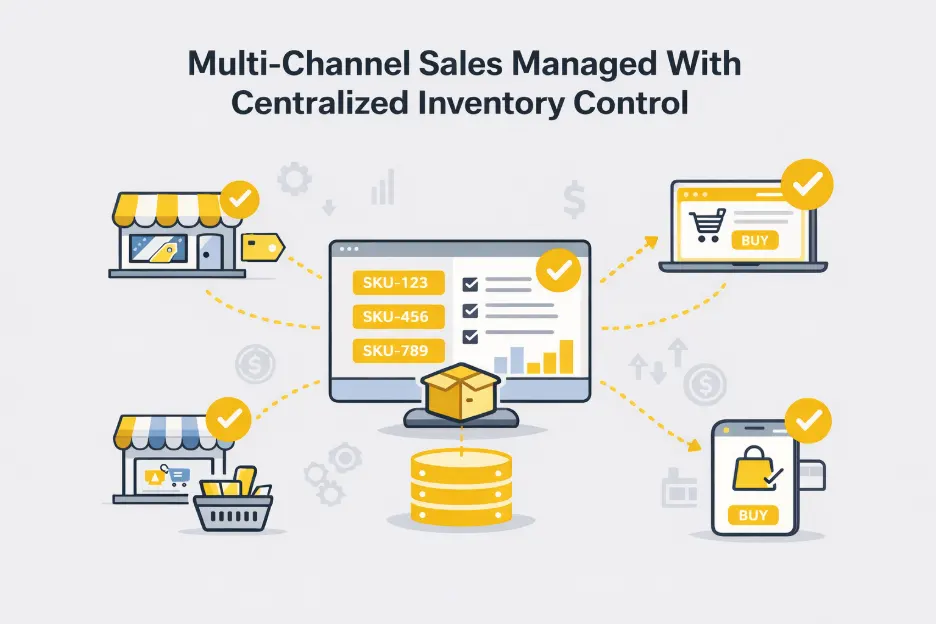
What this helps businesses eliminate:
- Product overselling
- Controlling order cancellations
- Avoid mismatching the stock at multi-channels
This trend supports scalable growth without operational mess.
9. Insight-Based Inventory Management
Instead of monitoring everything, systems now highlight only what’s going wrong.
How this helps businesses:
- Instead of keeping an eye on dashboards, teams focus on critical issues
- Faster corrective action plan
- Less operational overload
Inventory teams stop reacting to noise and start acting on real risks.
10. SKU Rationalization Driven by Performance Data
Free up your shelf space with smart SKU Rationalization, as not every product deserves your shelf space.
Inventory systems now analyze sales velocity, margins, storage cost, and demand consistency to identify underperforming SKUs.
How this helps businesses:
- Control dead stock
- Leaner catalogs
- Better utilization of warehouse storage
This trend supports profit-first inventory decisions.
11. Inventory Systems with Supplier Performance Tracking
Late deliveries and inconsistent supply don’t have to stay hidden anymore in 2026. By adopting the inventory and logistics management systems with advanced tracking features, you can now monitor suppliers’ performances as well.
This could be one of the top inventory management trends in 2026, that uncover lead times and increases fulfillment accuracy.
How this helps businesses:
- Stronger vendor negotiations
- No more reliance on fraudulent suppliers
- Improved production planning with responsible suppliers
With constant supplier tracking, the inventory data becomes a supplier accountability tool.
12. Dynamic Safety Stock Adjustments
Static buffer stock no longer works. Systems now adjust safety stock levels based on demand volatility and supplier behavior.
How this helps businesses:
- Less capital is blocked in the unused stock
- Protection during unpredictable demand
- Smarter buffer planning
Inventory stays protected without being bloated.
13. Inventory-Led Sales Planning
In 2026, sales targets now align with inventory reality. Cut down the hassle of checking stock levels at multiple tools. Inventory systems feed stock availability and demand signals directly into sales planning and promotions.
How this helps businesses:
- No more selling what can’t be delivered
- Promotions aligned with stock readiness
- Higher order fulfillment rates
Sales growth becomes operationally sustainable.
14. Batch or Lot-Level Inventory Tracking
For regulated and quality-sensitive industries, tracking by quantity isn’t enough. The next biggest top inventory management trends in 2026 will make businesses opt for inventory systems that now track batches, lots, and expiry details.
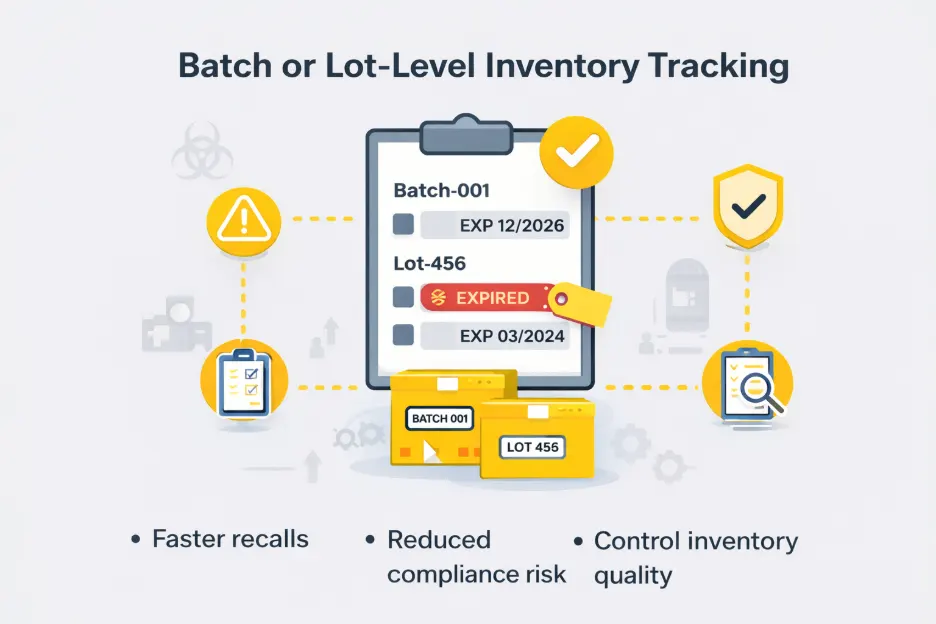
How this helps businesses:
- Faster recalls when needed
- Reduced compliance risk
- Allow you to control quality
By 2026, you will have inventory data that supports risk mitigation, not just showing the stock availability.
15. Demand-Driven Warehouse Allocation
The next top inventory management trends in 2026 will be organized Inventory placements in warehouses. There will be no random warehouse allocation happening further.
You need to opt for systems that analyze demand patterns to store products closer to where they sell most.
How this helps businesses:
- Conducting faster deliveries with optimized routes
- Lower transportation costs
- Improved customer experience
An improved inventory strategy can directly impact order fulfillment speed and lead to happy customers.
16. Smart Inventory Aging Analysis
Knowing how long stock sits matters more than knowing how much exists. So another top logistics management trend for ecommerce in 2026 is to actively track aging trends and movement frequency.
How this helps businesses:
- Early identification of slow-moving items
- Timely pricing or bundling decisions of dead stock
- Reduced write-offs
This trend prevents inventory from quietly draining profits and enables you to clear shelves quickly with no locking stocks.
17. Inventory Planning With Order Returns
As much as ecommerce or retailers are experience sky touching increase in orders, it’s time to now plan for returns as well.
It’s an alerting situation to have Inventory systems that can factor return rates into stock planning and forecasting.
How does this stock management trend in 2026 help businesses?
- More accurate net inventory levels
- Better resale and refurbishment planning
- Reduced losses from unsellable stock
Returns stop being a blind spot and can be accommodated in stock levels.
18. Inventory Cost Transparency at SKU Level
Inventory costs go beyond purchase price. Systems can now calculate storage, handling, insurance, and depreciation costs per SKU.
How this helps businesses:
- Better pricing decisions
- Identification of high-cost, low-margin items
- Improved profit forecasting
Inventory becomes financially visible and eliminates the hidden holes in the budget.
19. Role-Based Inventory Dashboards
Not everyone needs the same view. This will be another top inventory management trends in 2026, which allow you to access role-specific insights for procurement, finance, operations, and leadership.
How this helps businesses:
- Faster decision-making
- Reduced misinterpretation
- Clear ownership of actions
With the advanced access to the dashboard, inventory insights reach the right people at the right time.
20. Scalable Inventory Architecture
Gone are those days when spreadsheets were used to manage inventory systems. They are built to scale as your business expands.
They handle more SKUs, locations, suppliers, and channels without performance issues.
How this helps businesses:
- Smooth expansion without re-platforming
- Consistent processes across growth stages
- Long-term system reliability
Inventory systems grow with the business, not against it.
How These Top Inventory Management Trends Are Changing Business Decisions in 2026
The biggest driver of inventory and warehousing is Ecommerce sector. The way it is becoming complex and demanding with each passing year, inventory in 2026 is no longer just managed – it drives decisions.
The biggest shift businesses are experiencing isn’t the number of tools they use, but how inventory data influences everyday choices across teams.

Here’s what’s changing on the ground.
1. Inventory is now becoming a strategic input, not an Operational Output
Earlier, inventory teams reacted to sales and procurement decisions. But now, inventory data is more into guiding:
- What products need a quick promotion
- When to reorder the restock, depending on the changing demand
- Which suppliers to prioritize and through which warehouse
- Where to allocate stock to meet the quickest delivery
Businesses have stopped asking “Do we have enough stock?” and started asking “How to simplify inventory stock records?”
2. Faster Decisions With More Automation, Less Manual Intervention
Trends like AI automation, predictive planning, and smart alerts remove daily guesswork, repetitive manual tasks, and errors that lead to delays.
- No need to review multiple spreadsheets
- Chasing updates across departments
- Manually evaluating and correcting errors
Teams receive clear signals and next-step actions with detailed insights.
3. Inventory Data Now Directly Impacts Revenue
Inventory trends in 2026 connect stock availability with sales performance and customer experience.
This means:
- Fewer cancelled orders
- Higher fulfillment accuracy
- Better customer retention
When inventory aligns with demand, revenue leakage slows down.
Final Words
At the end of this blog, it is fair enough to say that these top inventory management trends in 2026 are all set to speed up the inventory and warehouse management process. These trends will provide better control over logistics, improve customer experience, and eliminate operational risks.
If you are wondering how to adopt these trends and what product will best fit your modern inventory management needs, then GOIS (Goods Order Inventory System) can be your ultimate choice. It’s built to accommodate the fast-changing inventory management needs and enables you shift from manual tracking to intelligent control. For more details, you can drop a query below.
Frequently Asked Questions(FAQ’s)
1. What are the top inventory management trends for 2026?
The top inventory management trends in 2026 may include AI Automation, real-time inventory visibility across locations, AI-driven demand forecasting, centralized inventory control, automated stock fulfilment alerts, and batch-level tracking.
2. Why do businesses struggle with inventory control even after using the software?
Because most businesses just use inventory tracking tools, which don’t connect with the other systems. Without real-time updates, automation, and unified views across teams and channels, inventory data quickly becomes unreliable. This is why businesses struggle to have complete control over inventory.
3. Can Inventory systems support business growth without increasing complexity?
Yes, when inventory management systems are designed to align with your specific business needs, they help you centralize data, automate route tasks, and scale with order volumes. This allows businesses to grow without having to coordinate between different systems.
4. What should businesses look for in inventory management systems?
Businesses should prioritize real-time visibility, centralized control, automation capabilities and scalability while choosing the inventory management system.
5. How does GOIS support modern inventory management trends in 2026?
GOIS is a next-gen cloud inventory management software that aligns with the latest trends in inventory management, offering a centralized inventory control panel, automation-ready workflows, scalable architecture, and more.

Naushad Ahmed 
Naushad Ahmed is a technology expert at Goods Order Inventory (GOIS) specializing in inventory management, order fulfillment, and warehouse operations for small and mid-sized businesses. He shares practical insights on inventory control, stock accuracy, automation, and multi-location management to help businesses move beyond spreadsheets, reduce stockouts and overstock, and scale their operations efficiently.