
Though at initial, it is rarely visible on a balance sheet, but gradually it eats into margins, drain cash flow and slow down the business growth.
No matter how strong inventory system you have implemented, it always have a risk to impact the entire business growth. Many companies assume their current system is “good enough” until operational complexity comes forward in the form of missed sales, and shrinking profits.
From excessive carrying costs to production delays and lost customers trust, the real cost of a wrong inventory systems actually goes beyond the software subscription fees.
So before you make a final decision about choosing the inventory management system for your business, let’s uncover the possibilities that you may face if you fall for low-grade systems.
Top Challenges That Highlight the Cost of a Wrong Inventory System
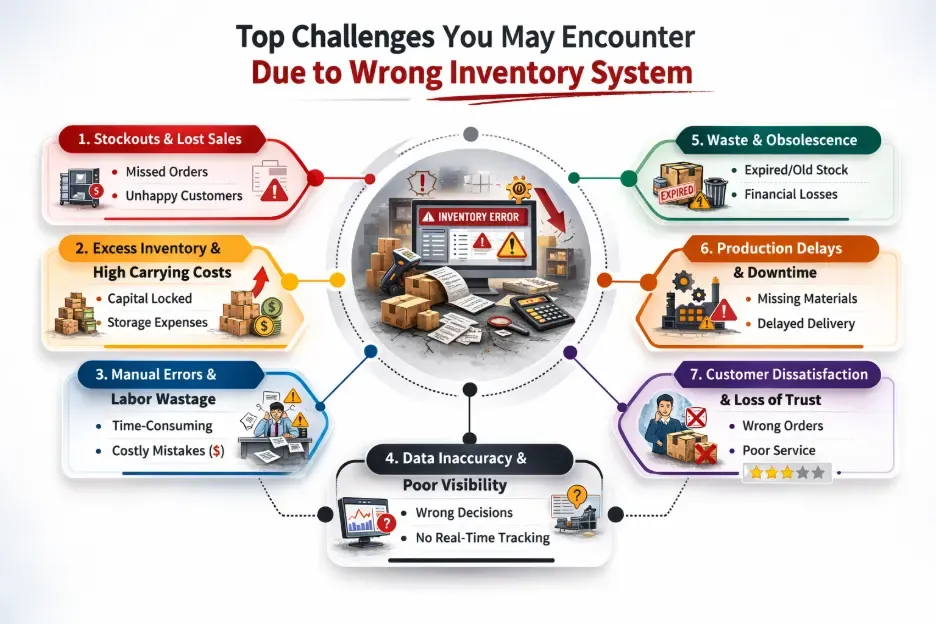
Excessive Carrying Costs That Eatup The Biggest Capital Share
If you are holding a more stock than you are selling due to lack of inventory visibility or accurate forecasting, then there are high chances of using a wrong inventory system.
On average, carrying costs can account for 20 to 30% of total inventory value annually. If you are still taking it lightly, then keep in mind that it includes:
- Warehousing expenses
- Insurance of inventory
- Cost depreciation
- Obsolescence
- Shrinkage
When your system fail to bring clearity between fast-moving and slow-moving items, capital gets locked into dead stock instead of fueling growth inventory.
Stop Letting Dead Stock Drain Your Capital
If 20–30% of your inventory value is silently disappearing into carrying costs, it’s time for clarity. Gain real-time visibility, separate fast-moving from slow-moving items, and unlock capital trapped in excess stock before it slows your growth.
Reveal My Hidden Inventory CostsStockouts Leading to Revenue Loss
Delay in data update leads to inaccurate inventory data and enable teams to work with outdated inventory data which often result into stockouts, which means losing potential sales.
The realization of cost of a wrong inventory system feels more when customers place orders for products that are not actually available in stock. Your spread sheets may reflect the numbers for the same stock but in reality it shows something different.
The result?
- Cancelled orders
- Emergency replenishment at 3 to 5x higher cost
- Frustrated customers who switch to competitors
Stockouts don’t just hurt today’s revenue they even cause long-term damage in trms of customer’s loyalty and not letting them coming back to your brand.
Production Downtime and Operational Disruptions
For manufacturers and distributors, inaccurate stock levels can halt operations entirely. Missing raw materials or incorrect inventory counts cause production delays that can cost thousands even millions per hour.
This hidden layer of the cost of a wrong inventory system impacts:
- Timeline of the project delivery
- Labor productivity
- Vendor relationships
- Overall supply chain stability
Downtime is not just inconvenient, it is financially draining!
High Labor Costs Draining Over Manual Corrections
If your team spends hours on sorting data in spreadsheets or reconciling mismatched data, then you might be at high risk of loss.
A wrong inventory system always make you rely on manual stock counts, fail to correct mis-picks and at the end you might be facing serious inventory management inefficiencies.
A single picking error can cost up to $100 when you factor in returns, re-shipping, and administrative time. Multiply that across hundreds or thousands of orders, and the Cost of a Wrong Inventory System becomes that you cant afford to ignore.
Instead of focusing on strategy and growth, your workforce becomes occupied with fixing preventable errors.
Waste, Complexity, and Shrinkage
If you are ending up with the poor tracking of your inventory, then you might be using a wrong inventory system. It often leads to expired, damaged, or obsolecent stock that is sitting unnoticed in warehouses.
Products decay, become outdated, or simply remain unsold until they must be written off.
These hidden inventory costs silently reduce profit margins and distort financial reporting. Without proper alerts and analytics, businesses continue purchasing items they already have further compounding losses.
Dissatisfaction of Customers and Long-term Damage to Brand
In the fastly moving scenario, customers expect accurate stock availability and fast fulfillment. When your system displays incorrect inventory levels, customers quickly lose their interest and trust in your brand.
The ultimater cost of a wrong inventory system expands into brand perception like:
- Poor fulfillment speed
- Order inaccuracies
- Delayed shipments
- Inconsistent service
Once customer trust is shaken, it’s always hard to retain them and you need to drain heavy cost to acquire them.
Audit, Compliance, and Reporting Risks
Inventory directly impacts financial statements. Inaccurate data can lead to compliance issues, audit failures, and misrepresented financial performance.
Businesses relying on outdated or fragmented systems often struggle with legacy inventory software problems, including:
- Lack of integration with accounting systems
- Manual data duplication
- Limited reporting capabilities
- Poor data transparency
These risks can result in regulatory penalties and strategic decision-making based on flawed data.
Slower Growth and Competitive Disadvantage
As companies scale, inventory complexity increases. Without automation and centralized visibility, operational complexity always retain shady.
The cost of a Wrong Inventory System becomes even more pronounced when:
- Order volumes increase
- SKUs expand
- Multi-location operations grow
- E-commerce channels multiply
If your inventory system cannot scale with your business, if your system is not scaling at the same pace.
What are the top signs of upgrading inventory system?
No matter how brilliant your inventory system is. What works best 5 years ago with 500 SKUs will not work in a same way after 10 years with 5000 SKUs.
Many businesses keep delaying modernization until problems turn into blunders. Here are clear inventory system upgrade signs:
- Frequent stock discrepancies
- Repeated manual stock counts
- Increasing write-offs
- Rising fulfillment errors
- Poor integration with ERP or accounting systems
- Limited forecasting visibility
If these challenges sound familiar, the cost of a wrong inventory system is already affecting your bottom line.
Final Words
The cost of a wrong inventory system is not just about software limitations. It is always mapped with lost profits, wasted labor, operational chaos, and damaged customer trust. Businesses are unknowingly losing 10-30% of their business growth due to poor inventory visibility, stockouts, inefficiencies and excessive carrying cost.
In today’s competitive business environment, meaning inventory seamlessly is the real backbone of your growth. You need a right strategy and modern inventory system that go hand-in-hand.
Modern, data-driven inventory management systems are more about just tracking the stock. It enables you protect margins, ensure seamless cash flow and support sustainable growth.
Frequently Asked Questions (FAQ’s)
1. What is the Cost of a Wrong Inventory System for small businesses?
Small businesses can lose up to 25–35% of operational budget due to carrying costs, stockouts, manual labor inefficiencies, and inventory write-offs caused by poor systems.
2. How do hidden inventory costs impact profitability?
Hidden inventory costs such as overstocking, shrinkage, emergency replenishment, and labor corrections reduce gross margins and tie up working capital that could be used for growth.
3. When should a company upgrade its inventory system?
A company should consider upgrading when it experiences frequent stock discrepancies, manual processes, rising fulfillment errors, poor reporting visibility, or scalability issues.
4. Can upgrading an inventory system improve customer satisfaction?
Yes. Accurate stock visibility, faster fulfillment, and reduced order errors directly improve customer trust, retention, and brand reputation.
5. How does a wrong inventory system affect financial reporting?
Inaccurate inventory data can distort balance sheets, impact cost of goods sold calculations, and create compliance and audit risks.

Naushad Ahmed 
Naushad Ahmed is a technology expert at Goods Order Inventory (GOIS) specializing in inventory management, order fulfillment, and warehouse operations for small and mid-sized businesses. He shares practical insights on inventory control, stock accuracy, automation, and multi-location management to help businesses move beyond spreadsheets, reduce stockouts and overstock, and scale their operations efficiently.