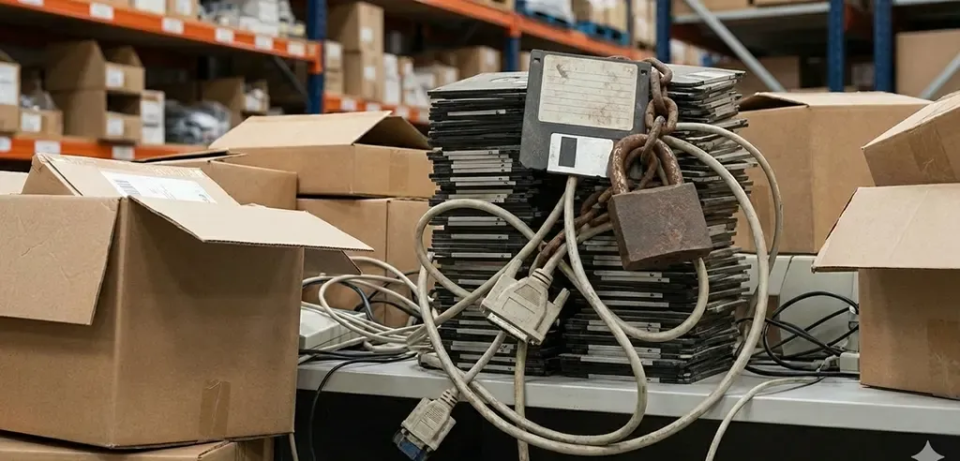
Well, inventory software problems don’t usually announce themselves loudly. They show up quietly in the form of late deliveries, frustrated teams, cash stuck in unsold stock, and customers asking questions, and your system can’t answer fast enough.
- Inefficient inventory management software directly impacts business profitability, amounting to approximate $1.1 trillion to $1.77 trillion.
- Confusing inventory decisions account for 53% of retailers’ unplanned markdown costs.
- 60% of retailers are still operating with inaccurate inventory data- leading to complexity in operations.
Running a business with inefficient inventory management software is a lot like trying to sail a boat with tiny holes in it. You spend all your energy scooping water just to stay afloat, leaving no time to focus on where you’re headed or how to get there faster. The work never stops, and neither do the problems.
When Legacy Software Becomes a Barrier to Growth!
For small and mid-sized businesses, inventory sits at the center of everything. Sales depend on it, finance is impacted deeply, and customer success pays the price when things go wrong.
Inefficient inventory management software usually relies on spreadsheets and manual processes. When inventory data isn’t accurate or connected, the issues don’t stay contained; they spiral across departments, making it harder to pinpoint the real cause.
That’s why inventory challenges are often misdiagnosed. Teams blame forecasting, operations, or fulfillment. But in reality, the root problem lies in the inefficient inventory management software that can’t keep up with how the business is evolving with the changing needs.
If growth feels harder than it should, or if scaling seems to multiply chaos instead of opportunity, it’s time to pay attention to your inventory management software.
There are clear warning signs that inefficient inventory management is holding your business back. Once you know what to look for, fixing them becomes far easier, especially with a connected, modern inventory approach.
5 Warning Signs of Inventory Software Inefficiency
If you are still lagging and failing to manage inventory, then here are a few alarming signs of inefficient inventory management software that you need to pay attention to now:
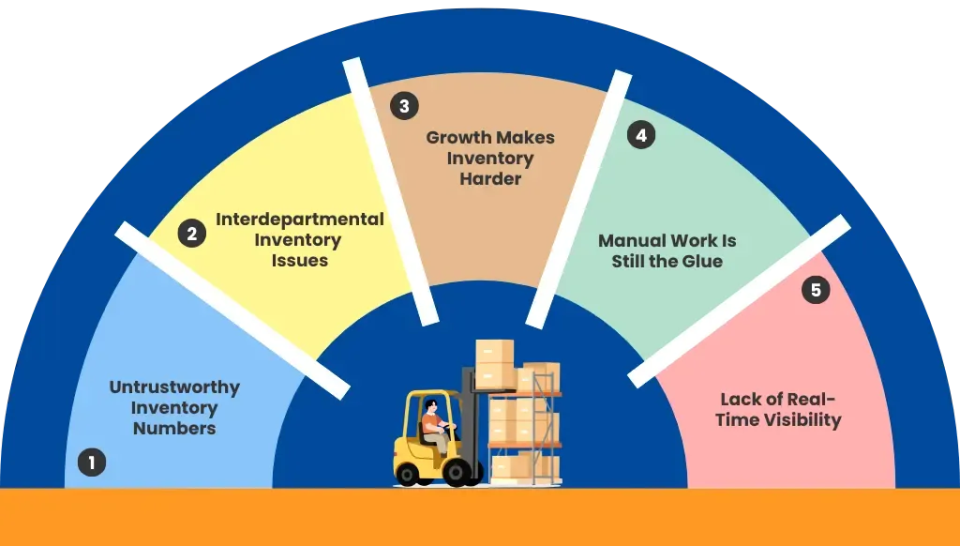
Sign 1: When You Don’t Trust Your Inventory Numbers
If you are constantly double-checking stock levels before confirming an order, that’s a red flag!
Inventory should be a source of confidence, not doubt. Yet many businesses operate with systems where numbers look fine on screen but don’t match in reality with the stock available on the shelf.
Teams start building workarounds- manual counts, side spreadsheets, messages to the warehouse. That’s not control, that’s a survival mode.
When your inventory software can’t provide accurate, real-time visibility, then teams often make decisions based on outdated data.
What this really costs you:
- Losing sales during peak time due to unexpected stockouts
- Blocking excessive cash in slow-moving inventory
- Teams relying on assumptions instead of data
If you don’t trust your numbers, you can’t truly control your inventory.
Sign 2: Inventory Issues Keep Spilling Into Other Departments
Inventory problems are rarely limited to warehouses…
If your inventory system is not working well, then be ready to answer the finance department, handle customer support, and deal with shrinking margins.
Finance will start questioning margins because stock valuation feels off. Might need to extend the customer support to deal with angry buyers asking about their orders. Leaders are struggling to forecast growth because demand data isn’t reliable.
This is where inefficient inventory management becomes dangerous and starts affecting the rest of the business.
Why Legacy systems are failing to consolidate the data?
When inventory software isn’t connected across departments, each team works with partial information. Everyone solves problems locally, but no one sees the full picture. The result? More meetings, more blame, and slower decisions.
Common symptoms:
- Finance and operation teams are always showing up with different inventory numbers.
- Customer teams promising availability, but they never been confident to confirm
- Leadership lacks a single source of truth
Inventory should connect your business, not fragment it.
Sign 3: Growth Makes Everything Harder, Not Easier
Growth is supposed to be exciting. So, if you your new sales channel, warehouse, or product line creates confusion, then it’s high time to realise that your systems is holding you back.
Many SMBs outgrow their tools without realizing it. What worked when you had 200 SKUs and one warehouse starts breaking at 2,000 SKUs and multiple fulfillment points.
This is where outdated inventory software shows its limits and started shattering. They aqe not designed ti scale, automation and capable to handle complexity. Legacy systems forces your team to carry the burded manually.
You might notice:
- Fulfillment errors are or delays increasing as volume grows
- Inventory planning is becoming reactive
- Hiring more people just to “manage the mess” and keep adding to the cost.
Scaling shouldn’t feel like adding friction. If it does, the foundation need to fix it with right solution.
Sign 4: Manual Work Is Still the Glue to Holding Things Together
Spreadsheets aren’t the problem; relying on them is a major issue.
If your team constantly exports data, reconciles reports, or manually updates stock after every sale or transfer, your inventory system is doing too little heavy lifting.
Manual work increases risk. Every copy-paste is a chance for error. Every delayed update creates blind spots. Over time, these small inefficiencies turn into missed revenue and operational fatigue.
Modern inventory software should automate routine tasks, synchronize data instantly, and reduce human dependency, not demand it.
The warning sign: When inventory accuracy depends on people remembering to update it, something is broken.
Sign 5: You Can’t See What’s Coming Next
Lack of visibility in Inventory management increase the chance of failure.
Inventory management is all about preparing for tomorrow, it isn’t just about knowing what you have today.
If your reporting only shows historical data and offers no insight into demand trends, aging stock, or replenishment needs, you’re always one step behind.
Businesses stuck with inefficient inventory management often:
- React to stockouts instead of preventing them
- Discover dead stock months too late
- Miss seasonal demand opportunities
Without predictive insights, inventory becomes reactive instead of strategic. And that limits growth.
Why These Problems Don’t Fix Themselves
Inefficient inventory management compounds over time. Small inaccuracies turn into large financial leaks. Manual work becomes operational drag. And leadership decisions get made with incomplete data.
The longer businesses rely on disconnected or outdated inventory software, the harder it becomes to unwind the complexity.
That’s why the solution isn’t another workaround, it’s a connected inventory foundation.
How GOIS Fits Modern Inventory Management Needs
GOIS is built for businesses that are looking to scale and are ready to replace all that outgrown patchwork systems and manual fixes.
Instead of treating inventory as a standalone function, GOIS connects inventory performance across sales, operations, finance, and fulfillment, creating one reliable source of truth.
What GOIS Changes:
- Ensuring real-time visibility across locations and channels and allowing you to operate with real-time data.
- Connected data flow between inventory, orders, and finance to make informed decision with confidence.
- Automated updates that reduce manual dependency and eliminate data risk.
- Actionable insights for forecasting and planning and replacing assumptions and guesswork.
- Scalability that supports growth without chaos and performance hiccups.
With GOIS, inventory software stops being a bottleneck and starts becoming a growth enabler. You spend less time managing problems and more time planning what’s next.
Frequently Asked Questions (FAQ’s)
1. How do I know that my business growth is affecting by inefficient inventory management?
If your team is spending excessive time in data reconciliation, stock accuracy or mapping data errors rather than focusing on strategies, then it’s time your inventory inefficiency is at alarming point.
2. How can legacy inventory system impacts the finance and customer experience?
The lack of transparency in inventory affects cash flow, margins, order fulfillment, and customer trust across the business.
3. When is the right time to replace inventory software?
When you feel that your business growth also increasing the manual workload, systems failing to integrate, or scaling creates complexity instead of efficiency.
4. What makes modern inventory management different from traditional systems?
Modern systems focus on real-time data, automation, connectivity, and predictive insights, not static tracking.
5. How does GOIS help reduce inefficient inventory management?
GOIS connects inventory data across the business, automates routine processes, and provides clear insights that support smarter decisions.

Naushad Ahmed 
Naushad Ahmed is a technology expert at Goods Order Inventory (GOIS) specializing in inventory management, order fulfillment, and warehouse operations for small and mid-sized businesses. He shares practical insights on inventory control, stock accuracy, automation, and multi-location management to help businesses move beyond spreadsheets, reduce stockouts and overstock, and scale their operations efficiently.