
Well, 73% of online ecommerce retailers say that accessing inventory visibility and synchronization among various channels remains their greatest obstacle.
However, the way the market for global inventory management software is growing and projected to make $5.5 billion by 2030, it’s clear that businesses are prioritizing automation over stock movement.
So, which inventory management solution is “Really Winning the User Experience Game based on offering feature sets”?
| Top 10 Inventory Management Systems to Watch Out For in 2025 – Read More |
With the availability of various best e-commerce inventory management software for small businesses, the majority of them are still in a dilemma about which IMS they should rely on. However, don’t worry; we have a comprehensive guide to provide a deep understanding.
From Panic to Control- IMS Fixing the Inventory Chaos!
Running multiple online stores sounds exciting until you realize how fast inventory can spiral out of control. One wrong count and you’ve oversold. One delay and your stock’s stuck somewhere between “ordered” and “out of stock.”
That’s exactly where E-commerce Inventory Management Software steps in!
Think of these Inventory Management Systems as your behind-the-scenes superhero. Not only does it help automate stock updates, sync orders, but it also gives you real-time visibility into what’s selling (and what’s not).
Whether you’re juggling to integrate Shopify, Amazon, or WooCommerce, a good online inventory management system makes sure every sale, stock update, and purchase order is on track. No spreadsheets, no guesswork- just a smooth selling experience.
Why Inventory Software Is the Secret Weapon of Online Sellers
Behind every smooth eCommerce operation, there’s one quiet hero — inventory software. It’s the system that keeps your sales channels, warehouses, and suppliers in perfect sync.
And in today’s hyper-competitive online space, not having one is basically flying blind.
Here’s why it matters:
- Real-time tracking: A whopping 43% of small retailers say they’ve lost sales because of inaccurate inventory data. Real-time stock tracking stops that loss cold.
- Centralized control: Managing all your channels (Shopify, Amazon, Flipkart, WooCommerce) from one dashboard can cut manual work by up to 60%. Explaining below how it works:

- Smart automation: Businesses using automated order syncing see 30% fewer order fulfillment errors. GOIS ensures a next-gen inventory management solution with AI-powered automation features.
- Cloud-based access: With 78% of retailers now using cloud-based inventory management systems because flexibility is the new norm. Here, learn how does cloud inventory management system actually works.
- Instant Reminders: No one wants to find out they’re sold out after checkout. Automated alerts integrated in IMS save time and reputation.
- Easy to Integrate: Tools like QuickBooks, CRMs, and shipping platforms plug in easily, giving you a single source of truth for every order and item. To make it work flawlessly, GOIS offers API integration.
The result? No more “where did that order go?” moments. Get visibility, strong inventory control, and confidence with IMS.
And here’s where GOIS really outshines. It doesn’t just keep track on numbers, but also gives your team real-time decision power.
Feature Wars: Who’s Offering What?
Every e-commerce inventory management software claims to be “the best.” But when you dig deeper, the difference lies in real-world usability.
So, how to choose inventory management software for E-Commerce? Compare it on: how fast it syncs, how clean it looks, and how well it plays with your favorite tools.
Here’s a quick feature comparing the top names side by side and help you pick the best one based on features and user experience:
Feature Comparison: Which E-commerce Inventory Software Offers the Best?
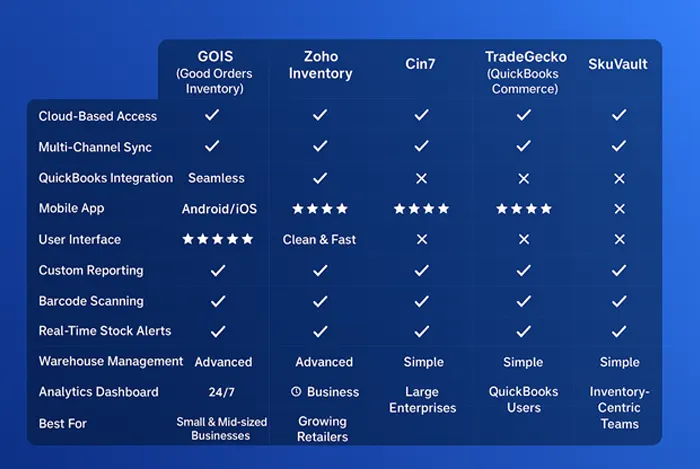
In a nutshell, don’t chase the buzzwords. Look for speed, usability, and solid integrations to win the game. That’s the trio that turns any inventory software into your real growth partner. And GOIS nails all three and provides custom extensions to better for inventory management.
E-commerce Inventory Management Software Comparison: Which Delivers the Best User Experience?
When it comes to E-commerce Inventory Management Software, user experience and seamless platform navigation aren’t a “nice-to-have option” – it’s everything. The smoother the interface, the faster your team can act and react to the errors.
Let’s be real here. Most platforms promise automation and excellent visibility. But do they all actually deliver or match the frictionless experience?
Here’s how leading tools stack up when it comes to usability:

What stands out:
- GOIS scores high for usability and speed, ideal for fast-moving and interconnected teams.
- Cin7 offers deep features but can feel bulky or complex for small sellers.
- Zoho and SkuVault perform well for mid-sized stores but lack real-time agility and ease of access.
If your business runs across Amazon, Shopify, and WooCommerce, you’ll want a multi-channel inventory software that syncs instantly, not even minutes later. GOIS boasts its real-time automation engine in its ecommerce inventory management software.
Plus, GOIS’s order and stock management software module ties directly to QuickBooks through seamless API connections – which makes it one of the few e-commerce inventory management software with QuickBooks integration that’s truly plug-and-play.
For sellers looking to simplify inventory tracking for online stores without losing control, GOIS hits the sweet spot between simplicity and depth.
Your Must-Have Toolkit for Stress-Free Stock Control
An effective multi-channel inventory software isn’t just about tracking SKUs. It must provide you with complete business control from purchase to delivery. The best platforms combine automation, analytics, and integration to make stock management nearly hands-free and visible.
Here’s a quick look at what separates a good system from a great one:
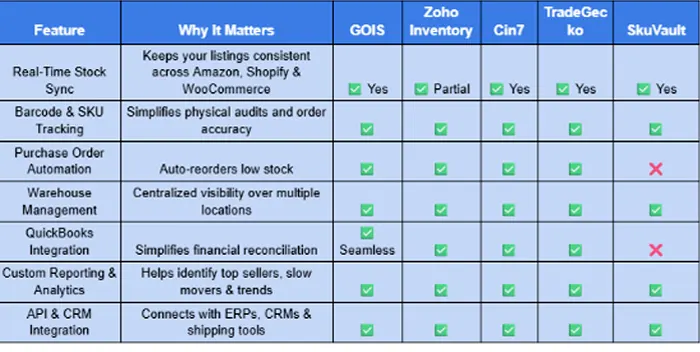
Expert Opinion:
Managing inventory across multiple e-commerce platforms can get stressful. Chasing duplicate listings, overselling, and mismatched reports are common pain points.
GOIS eliminates these by unifying your sales, stock, and financial data into a single dashboard.
So, whether you’re running 2 stores or 20, the system acts as an order and stock management software that keeps everything synced, transparent, and smooth.
In addition, its QuickBooks integration ensures your accounting always reflects real-time stock changes – so no manual entries and end minute no surprises.
In short, for sellers serious about inventory tracking for online stores, GOIS offers a balanced blend of automation and insight — exactly what fast-scaling e-commerce teams need to manage modern ecommerce inventory requests.
The Final Verdict: Who is the winner based on user experience and feature sets?
When it comes to e-commerce inventory management software, there’s no one-size-fits-all. Each platform shines in its own way. Some focus on enterprise-scale analytics, while others nail down simplicity and automation.
But if your goal is to manage inventory across multiple e-commerce platforms without drowning in spreadsheets or duplicate data, then GOIS takes the momentum for all the right reasons.
Here’s why:
- Collaborated Dashboard: See every channel, order, and warehouse in one clean view.
- Using Automation- First Approach: From purchase orders to restocking, it removes the repetitive manual grind.
- Blending Smarter Insights: Custom reports that show what’s moving and what’s stuck.
- Seamless Integration Powerhouse: An e-commerce inventory management software with QuickBooks integration, CRM connections, and open APIs to sync every tool you rely on.
- Cloud-Based Flexibility: Manage everything on the go with a cloud-based platform- your business never pauses.
Conclusion
If you’re selling on Amazon, Shopify, or multiple online storefronts, your software should work as fast and seamlessly as your customers expect. GOIS delivers all with the perfect in mind. The platform is not just designed with the best choice of features, including real-time control, automation, and clarity- but also user experience baked right in.
Ready to take charge of your stockroom and sales data like a pro? Let’s connect to understand how GOIS can transform your online inventory management process.
Frequently Asked Questions (FAQs)
1.How is an Online Inventory Management System different from basic spreadsheets?
Unlike basic spreadsheets, online inventory management systems are highly efficient for tracking real-time data. It ensures automatic updates across channels and sends alerts for low stock- such capabilities that spreadsheets can’t simply deliver. This is why fast-moving ecommerce companies opt for proper IMS to keep up with their stocks.
2. Why should I choose a multi-channel inventory software rather than a single-channel tool?
If you are selling products on multiple platforms like Shopify, Amazon, and WooCommerce, then you need a tool that seamlessly syncs all the stock, orders, and listings across the channels. A trusted multi-channel inventory software prevents overselling, stock mismatches, and costly manual work.
3. What feature sets make a true difference when choosing the e-commerce inventory management software?
While customizing or choosing a ready-to-integrate IMS, focus on below features:
- Automated purchase orders
- Real-time stock alerts
- Barcode/SKU scanning
- Custom reporting
- Warehouse/fulfilment workflows
4. How to decide which e-commerce inventory management software is right for my business?
To make the right decision, evaluate the number of channels you sell on, volume of SKUs, required integrations, mobile compatibility, budget, and support. Based on these, compare tools and don’t just fall for marketing claims.
5. Can GOIS manage multiple warehouses?
Absolutely. GOIS lets you manage inventory across multiple warehouses or fulfillment centers with ease.
You can view stock by location, transfer items, and fulfill orders from the nearest warehouse — saving both time and shipping costs.

Naushad Ahmed 
Naushad Ahmed is a technology expert at Goods Order Inventory (GOIS) specializing in inventory management, order fulfillment, and warehouse operations for small and mid-sized businesses. He shares practical insights on inventory control, stock accuracy, automation, and multi-location management to help businesses move beyond spreadsheets, reduce stockouts and overstock, and scale their operations efficiently.