But most companies don’t recognize the threat until margins start shrinking, warehouses start overflowing, or customers start walking away.
In a supply chain, inventory is capital. Imagine this—you are running an e-commerce store or managing a warehouse. Your shelves are packed with stock, orders are rolling in, and customers are expecting same-day delivery. Sounds exciting, right?
Don’t let inventory risks drain your profits
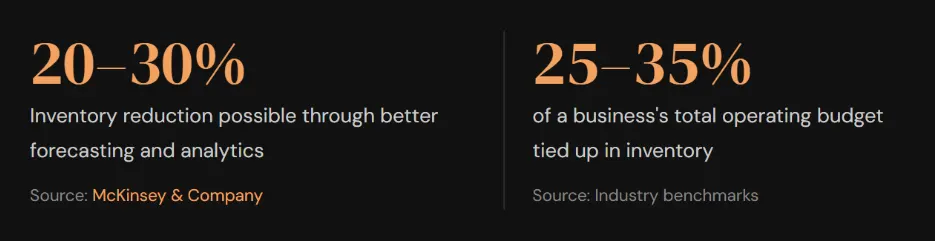
Stockouts, overstock, and blind spots cost businesses up to 35% of their operating budget. GOIS gives you real-time visibility and smarter forecasting to stay ahead.
Schedule Your Free DemoIt is, until you don’t know what you have in stock, what’s running low, and what’s just gathering the dust on the shelf. Quickly, your business can lose money than you make it if you are lacking real-time information about inventory.
This is where inventory risk started creating a doom!
Here’s the uncomfortable truth: your inventory isn’t just stock sitting on a shelf. It’s tied-up capital, demand assumptions, supplier reliability, and customer expectations—all bundled into one. When even one part of that equation goes wrong, the ripple hits your revenue, operations, and brand reputation simultaneously.
Let’s get into the details of what inventory risk really means and how it will impact your business.
What is inventory risk and its impact on business?
Inventory risk aligns with the financial loss that a business faces because of inefficient, imbalanced, and unpredictable inventory conditions. Inventory risk is not a single event—it’s a category of ongoing exposures that affect how well your stocks serve your business goals.
Think of every product on your shelf as a bet—sometimes it pays off, and sometimes it loses. The smarter your inventory strategy, the lower the inventory risk will be, and the fewer losing bets you place. At the end, more working capital you actually keep.
If you are still wondering the how inventory risks can impact your business, then take a quick look at these stats:
- Inventory distortion are one the major risks that make retailers lose nearly $1.75 trillion every year.
- 43% of small businesses don’t track their inventory or use a manual process which leads to inventory discrepancy.
- Cycle count inaccuracies let to 1.2% phantom shrinkage in warehouses.
Why are Inventory Risks Growing Harder to Ignore?
Managing inventory has never been more complex. Global supply chain disruptions, e-commerce acceleration, shorter product lifecycles, and unpredictable demand swings have turned routine stock decisions into high-stakes judgment calls.
If you’ve ever asked yourself “why is so much cash stuck in inventory?” or “why are we constantly firefighting stockouts?” you’re already living inside inventory risk. Now it’s time to detect that what kind of inventory risks you are dealing with and how they are costing you
Major Types of Inventory Risk and What They Actually Cost You
Let’s go deeper to each inventory risk and understand how hard it hits to your business revenue and growth…
1. Overstocking: When Playing With Too Much Inventory
Overstocking doesn’t just occupy space- it blocks the liquidity. Carrying cost alone can account for 20-30% of total inventory value annually.
Most businesses opt for bulk purchasing to snag the discount, but who knows that stock will keep sitting on the shelf for next six months blocking the cash flow.
Overstocking not just inflates storage cost, but also raises insurance premiums and risk obsolescence especially in the fast moving sectors like tech and fashion.
2. Stockouts- The Invisible Revenue Leak
Constantly missing on sale because of empty shelf? The repeated incidents will make your customers move to the competitors and they never returns. This practice compounds quietly over time.
According to the reports of IHL, worldwide retailers are losing billions annually due to stockouts.
In an era of one-click alternative, showing “out-of-stock” often means “out of consideration”.
3. Poor Demand Forecasting— The Root of Most Inventory Problems Starts with Assumption
Bad demand forecasting isn’t just a single problem- it creates a chain of hurdles. Overestimated demand and you overstock the inventory. Underestimate it and you hit stockouts.
Ignore seasonal spike, and you’ll be over-ordering in January and scrambling in December.
This is exactly where inventory optimization software and predictive analytics separate high-performing businesses from the rest. If you’re thinking that static spreadsheets can help you keep up with dynamic markets- then you are badly mistaken.
4. Obsolescence- The Slow Bleed You Don’t See Coming
Not all inventory loss is dramatic. Some of it just sits there and quietly losing value. The research from Deloitte, shows product lifecycles across many industries have shortened by up to 25% over the last decade. This means the window to set all full price is getting smaller.
When products expire before they sell, the write-offs hit your balance sheet directly and with no warnings.
5. Supplier Risk- You’re Only as Strong as Your Weakest Link
Late shipments, quality issues, poor delays- all are supplier disruptions that can twist your entire inventory plan even when your internal processes are running without any friction.
Everyone noticed the COVID-era where supply chain crises had brutally exposed global networks. This is where diversified sourcing and real-time supply chain visibility tools are no longer optional. They’re a core part of modern inventory risk management.
6. Shrinkage- The Physical Side of Inventory Risk
According to the National Retail Federation report, inventory shrinkage costs US retailers over $100 billion annually. It can be through anything either theft, administrative errors, vendor fraud, or product damage.
And the most scariest part, many businesses don’t detect it until they conduct a audit. The automated tracking, barcode systems and real-time reconciliation can dramatically close this gap.
How Inventory Risk Goes Beyond The Warehouse?
Inventory risk doesn’t goes stay in one department. It circulates outward quickly before even you realise. Here’s how:
| Function | How Inventory Risk Shows Up |
|---|---|
| Finance | Reduced liquidity, increased write-offs, lower profitability |
| Sales & Marketing | Failed promotions due to stockouts, missed upselling opportunities |
| Operations | Production disruptions, reactive firefighting instead of planning |
| Customer Experience | Longer fulfillment times, order cancellations, negative reviews |
Top Practices to Control Inventory Risk
There is no single fix to protect inventory risk, but if you have a clear direction, you can easily safeguard the risk.
- Upgrade your forecasting by replacing static spreadsheets with predictive, data-driven models.
- Track inventory in real-time to get complete visibility and identify the root causing issues at the initial stage.
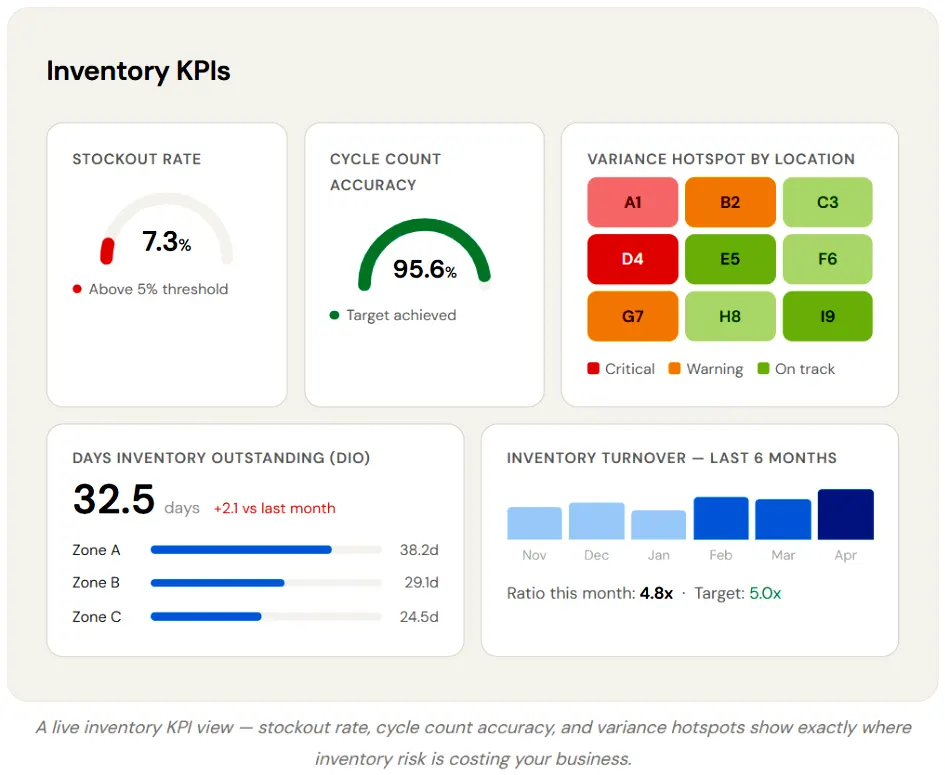
- Monitor your inventory turnover ratio to detect what items are moving slow to trigger action in time, instead of waiting.
- Diversify your supplier base to avoid depending upon a single source in a single point of failure.
- Optimize safety stock strategically not too high, not too low, calibrate to actual demand variability.
If you’re exploring technology to support this, our guides on AI in supply chain management and predictive inventory analytics are a strong next read.
Final Words
Inventory risk is manageable, if you’re paying attention to the inventory at the right time. The real danger isn’t that inventory risk exists, its when you are ignoring it until the margins disappear.
Businesses that proactively tracking and managing the types of inventory risk free up working capital, serve customers better and scale with far less friction.
Those that keep ignoring the alarming signs, will keep firefighting the same problems quarter after quarter. The question isn’t that inventory risk is affecting your business- it already is. But the question how you are managing it strategically. This is where GOIS can be your strategic partner for managing order and inventory.
You can contact us for the practical solutions and expert advice!

Naushad Ahmed 
Naushad Ahmed is a technology expert at Goods Order Inventory (GOIS) specializing in inventory management, order fulfillment, and warehouse operations for small and mid-sized businesses. He shares practical insights on inventory control, stock accuracy, automation, and multi-location management to help businesses move beyond spreadsheets, reduce stockouts and overstock, and scale their operations efficiently.